
IN AN ERA OF BIG BRANDS collaborating with Indigenous designers and Indigenous Fashion Weeks happening across the country, Virgil Ortiz was the first, or as he says, the OG. Virgil made purses with Donna Karan, curated fashion shows, sold $100 t-shirts at Santa Fe Indian Market, all when even the idea of social media or the internet or the term influencer existed only in the minds of the keenest sci-fi creators.
Speaking of sci-fi, ever since the early days of his work, Ortiz has incorporated science fiction into his art, whether it be ceramics, fashion, and now sculpture and film. Virgil’s latest exhibition opens in collaboration with the inaugural Santa Fe Magazine Festival on June 12-14, so we sat down with him and his artistic partner, Eric Garcia, to learn about what the two have in store for Santa Fe’s newest museum. This is a special exhibition for Virgil as it happens where everything began for him: right in the heart of downtown Santa Fe.
By the way, most people who gain this kind of international superstar reputation tend to take on some diva-like qualities. Yet nothing could be further than the truth with Virgil. In fact, no one has a bad thing to say about him. — JR
Virgil, you were on the topic of the Pueblo Revolt 15–20 years ago, before people even knew what you were talking about. Talk about those early days of acceptance versus now.
Virgil: It was actually 24 years ago when we started doing the shows with Charles King at his Scottsdale gallery. At first, people were tripping out — including my team — like, What in the hell are you talking about? These futuristic kind of aliens? But once the shows came to fruition, I explained what I was talking about. They didn’t fully understand until I made the signature piece for each exhibition, whether at a gallery or a museum. Then they got it. It was awesome to have that friendship with Charles — he let me, or rather agreed with me, to create what I wanted and go with that storyline.
I feel like I’m an OG now for talking about the Revolt. That was my prayer from the beginning — that all the upcoming generations of artists from New Mexico Pueblo ancestry would start talking about their revolt, because nobody was talking about it. It was being swept under the carpet because of the atrocities — the murders, the imprisoning, capturing people to build churches, the conquering of our lands. Educating globally about the 1680 Pueblo Revolt using art has been my life’s mission, and each one of my shows is based on that.
What was the spark for you to connect the historical to the futuristic, the science fiction aspect of your work?
Virgil: I’ve always loved sci-fi movies. I remember it was during Indian Market time when Star Wars came out — I was six years old. Instead of staying at Indian Market, we’d all hike down to the DeVargas Center and stay all day in the cinema watching Star Wars repeatedly. I learned all the characters, what spaceships they flew, where they came from, how they dressed, what language they spoke — all their roles. Then coming home and watching Battlestar Galactica, Star Trek — all the sci-fi themes.
When I got older, I thought, How many people can I reach, and what’s the biggest and easiest way to reach a lot of people? The answer was creating a feature film. So, twenty-four years ago, I started developing a storyline — a script about the Pueblo Revolt happening simultaneously in 1680 and 2180. I’m not an academic, so I chose to tell it visually and to create superhero roles in the future for Pueblo people and everyone in general. It’s all based on women’s empowerment, with a female head character through whom we see the retelling of the Revolt. That’s how it all started — being deeply connected to all those sci-fi movies and TV shows back in the day.
Nowadays the correct term is reclaiming the narrative, but you were doing that before anyone even knew what that meant.
Virgil: I always tell people at lectures — collectors, whoever — that it’s not my talent. I’m a conduit, from spirits or from a higher place. The reason I’m here is to make sure our traditions of creating Cochiti Pueblo pottery using old school, traditional methods and materials don’t die out. It is a dying art form, sadly, just because people don’t have enough time to dedicate to it. But growing up in a family of potters on my mom’s side, I’ve been doing it since I was a kid. We have pieces now at the Wheelwright Museum — pieces my mom bought from us when I was 6 years old.
I got the messaging from our ancestors, and learned how to reach a bigger amount of people with the prayer that all upcoming generations can learn from it, so we don’t repeat the process. But it’s not taught in schools; it’s not in our history books, because of the genocide and bloodshed. I want to make sure there is acknowledgment for all Indigenous Pueblo people — the reality of what we went through, and that we’re still here, surviving, creating and living.
And it’s amazing that my friend Eric, of 30 years, has Spanish ancestry. This is the first time I’ve invited a collaboration with a person from Spanish roots — to show both sides, and to show the world that we’re compatible, coexisting and living together, showing the continuum of what happened in history, the present day, and the prayer for the future.
Cochiti is a very special Pueblo — one of the only ones that’s always had an Indigenous name, and one of the older Pueblos. What are some of the stories you were told as a kid about the Revolt, through Cochiti history?
Virgil: I didn’t hear much about it in public school. But at home, you always heard stories. When your grandparents are talking — This is how it used to be. This is when we escaped. This is how we moved into the cliff areas for protection. All the stories of how close we are with the earth, how we work with the earth.
All the mountains have names — we would go there to seek refuge and protection. You’d hear about how there are still Spanish families living on the reservation. We intermixed. You’re not taught about that, but you realize, Oh, there are Spanish people still living here on the Pueblo.
You hear stories like that after ceremonies, or in individual homes, people talking about how it used to be; leaders now trying to trace back the ancestry — how some of us have blue eyes, curly hair or light skin. Ortiz is a last name there. Most Pueblo people have Spanish last names because my real last name is Hopane — which means oak tree. They couldn’t pronounce our names. My whole name is Gupee Hopane. So they couldn’t pronounce them and had to give us their names instead.
Talk about how you decided to reach out to Eric, how your friendship started, and where it’s evolved.
Virgil: We just started as two artists back in the day — we met a long time ago, 30 years ago. Then, lo and behold, we reconnected through some of my gallery shows. Eric came in, purchased some of my artwork, and we started talking. I was like, Dude, we should do a collaboration.
Eric: I hadn’t seen Virgil in over 30 years. I’m originally from New Mexico — I was born in Santa Fe. We had a lot in common from the get-go. We both took an advertising and marketing course in New Mexico and just hit it off. Virgil was super talented. We were both illustrators, so we had a lot to talk about. It’s kind of funny — I took the advertising and marketing route, and he took the fine art route. I always wished I’d taken that fine art route, but I’ve done well in advertising. I started doing a lot of structural design for large-scale public art.
At the time I reached out to Virgil — after not seeing him for 30 years — we bought several of his pieces. I said, Virgil, we’ve got to work on a piece together. Let’s work on some large-scale public art. He said, Let’s do it. Just like that. And when this opportunity came up with the Vladem, he said, Hey, I’ve got the perfect opportunity. I was like, This is fantastic.
It touches on the topic of the Revolt, from the creative visual perspective of Spanish art — my ancestry is from Spain and Mexico, and then Native American. Both Virgil and I are rooted in this story. It’s very much a testimony of our lives and the product of our ancestors’ decisions. From the very beginning, Virgil’s mission was to educate, to keep people engaged — especially young people. Helping to set the backdrop is a wonderful privilege, really, to help him continue that platform of the Revolt.
Tell me about what the collaboration will actually look like in the museum.
Virgil: It’s so cool. We’re starting — you’ll see the first collaboration when you’re coming up the stairs at the bottom. There will be a lot of wall pieces going up there. We talked with the interim director, had walkthroughs, and they were completely down for it — Oh my god, you guys can take over this whole spot, activate this whole area.
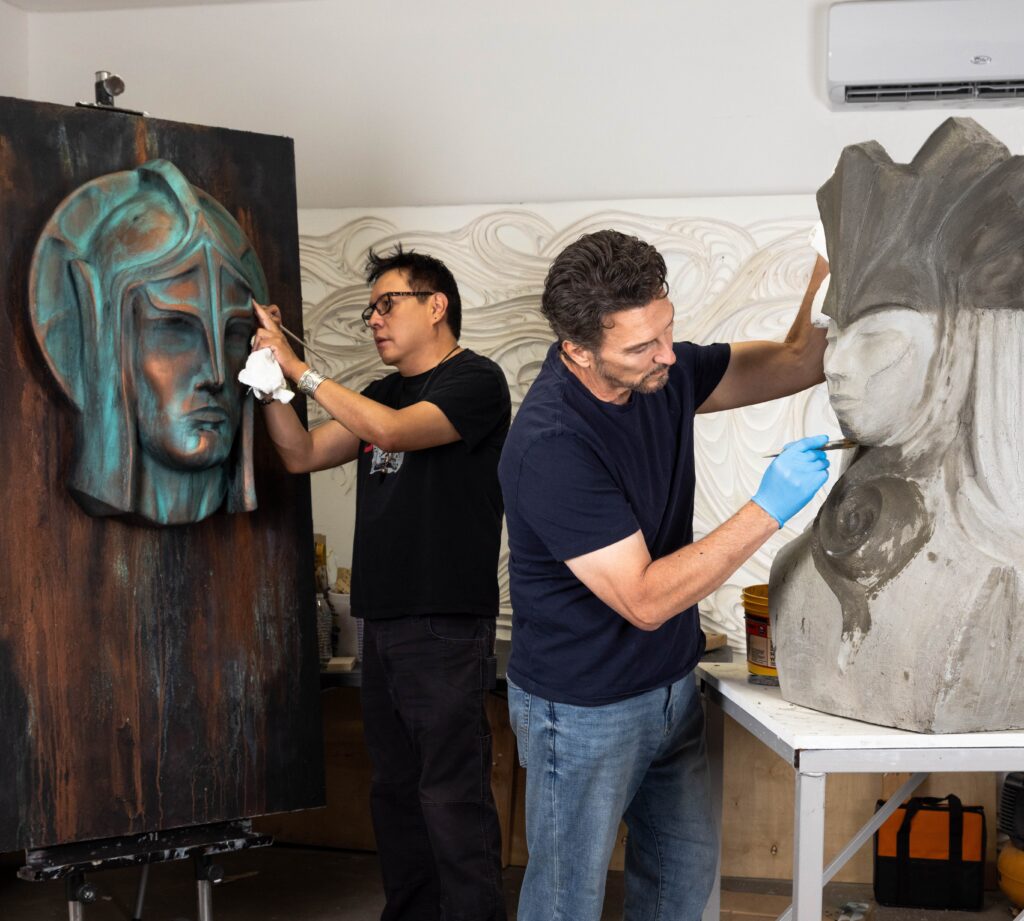
We thought the best way to decorate the stairwell leading up to the title wall. There are so many different types of 3D sculpture mixed with clay, mixed with different types of sculpture adhered onto boards and canvases. Then once you get to the title wall, Eric had started a painting a long time ago, and when I saw it, I was like, Oh dude, this would be the perfect image for the title wall. We could both do paint work. So we came up with that idea.
Eric: Like Virgil said, I sat on this painting for a long time — I had started it about 30 years ago, around the same time I met Virgil. Revisiting it, I thought it sort of falls into the narrative Virgil had created, because at the time of 1680, the Baroque period was very popular in Europe. And a lot of the design I had done, without real intention, was this very whimsical, theatrical, sort of Renaissance painting. I did some research and realized the period of this painting is actually the 1600s. I said, Virgil, I want you to collaborate with me on this painting. Everything has just sort of fallen into place. The two characters I painted are Spanish characters — it’s really going to work well when Virgil gets ahold of it and finishes it. In a sense, that was the beginning of that relationship and that creative collaboration.
So you’re going to paint, and Virgil are you going to sculpt three-dimensionally on the canvas?
Virgil: On some of them there are various things we’re collaborating on with different mediums, but just for the title wall — I’ll finish the painting with a third character and make him more Indigenized, more global looking, but still referencing that time frame, the Renaissance and Baroque periods, showing the intermixing that was happening way back then.
It tells the whole continuum of the exhibition’s narrative. And my plan is to go into the archives of the Museum of New Mexico Foundation and all the museums, and borrow pieces from that time period — historic works — to show the whole timeline. I try to do that with all my exhibitions: bring out some historic work, then show my traditional work right next to it, using the same methods and materials. Only time has changed. Then we go into high-fire pottery, into painting, into 3D mapping projection, into pieces encapsulated in resin. It spans from the continuum of women’s roles way into the future, utilizing all different types of mediums. And what I’ve been experimenting with is going to make this an exciting show, especially for Santa Fe.
Is this your second show with the Vladem?
Virgil: Yes. I was in the inaugural exhibition when it first opened, but it was a group show. I didn’t have a chance to really turn the music up, you know — really activate the space. I had some projection, but it was quiet. Now I’m turning the whole artist studio upstairs and the Vladem into a projection mapping room with music fully involved. It’s going to encapsulate the viewer, take them into the future and show them some of the past.
The large-scale high-fire sculptures will sit on pedestals in front of the projection wall, and you’ll also be encapsulated by the projection behind them. And Santa Fe will get to see all of my original garments, the character designs — everything you’ll see within the projection, you’ll see the original costuming I make. It’s a return to the fashion side, to show Santa Fe what they’ve known me as — doing fashion shows — but tied into the development of the whole characters and feature film.
So you’re able to see the original designs and garments, and then walk into the next room with projections of the models wearing them?
Virgil: Yes, and the actual garments will be there. You know the Vladem layout — I call it the fish tank, behind the big glass doors before the artist residency room. We’re going to turn that into more of a fashion garment display, with TV monitors showing the full scope of the fashion side of my work. There will be a little section specifically for fashion. The rest of it is all different types of sculpture and paintings — the whole show will tie together.
You were really the first kind of rock star Native artist — after Fritz Scholder, of course. You were doing collaborations with Donna Karan, fashion shows — all of this 30 years ago. And there are probably people who don’t even realize that.
Virgil: I feel like the OG. I’m getting older and I’ve been doing this a long time, but it’s all good. I was happy to break down some of the doors and give our people a taste of what manufacturing for clothing and fashion could look like — how to work at a bigger level, how to protect your intellectual property, how to secure your IP so you don’t get ripped off, which always happens.
You see it online. How to be aware of what you post — it’s forever once it goes online. There are different ways of adapting your work to represent the sacred stuff that we cannot put online.
Another goal was to have Indigenous artwork labeled as fine art rather than arts and crafts. Take the example of Renaissance painters and sculptors. Yes, they’re long ago, yes, they’re super famous fine artists, but look at our Indigenous world, our Pueblo people. We’ve been doing ceramic work for thousands of years — way longer than the so-called Old Masters — yet it’s still considered arts and crafts. That’s something I’ve been fighting to change, going after non-Indigenous venues as much as I could, way back in the day.
Now I’m one of the only artists featured at The Fondation Cartier — they have 32 pieces of my family’s traditional work on constant display right next to the Louvre. That has always been my goal: not to be pigeonholed as an Indigenous artist, but as an artist.
American painters started doing abstract work after the Armory Show in 1913, but Pueblo pottery had abstract designs going back to the 1860s.
Virgil: Oh yeah. We have samples going back thousands of years. I went into the vaults at the Colorado History Museum and they had no idea they had pieces thousands of years old. It was such a cool little display — a small pot from thousands of years ago, then a sample from the late 1800s, and then I made the same size pot using traditional clay. They all talked together in the same display case.
And that’s what I want to do at the Vladem — possibly bring in artwork from the Spanish side as well, right next to it, to show that art was our newspaper. It was a way of documenting time. That’s what all the figurative Cochiti clayworks were doing — they’re all based on cultural commentary.
You can basically read the time period when more people came into the area — the restaurants, the operas, the circuses. Then now, what you’ll see at the Vladem is me working with resin to encapsulate traditional artwork, which is really fun. My head character — she’s played by Leslie Banks, an Indigenous woman who I started working with when she was 17 years old. She was my associate Tish’s mom’s daughter. She’s now 37, two kids later, still the same. She’s a runner, stayed in shape her whole life. Now she’s bringing her daughter to play her as a younger blind archer — that continuum again. She’ll be holding a cube of resin, with a Po’pay sculpture inside the resin, to explain the time jumping and how 1680 and 2180 come together.
The reason I’m putting things into resin is my idea to preserve the knowledge of how to create traditional Cochiti artwork. If it’s encapsulated in resin, I’m going to engrave on the outside — with laser engraving — the exact coordinates and instructions for how to make our traditional artwork. But it will be written in a code I first created in 6th grade, so it has to be decoded over time. Once decoded, you can follow those directions to make sure the art form never truly dies out. It’s thinking way into the future about preservation while also reaching way back to history inside the resin.
Tell us a little more about some of the other works for the show.
Eric: It’s going to be a wide variety of different media — I probably couldn’t count the mediums on both hands. We have ceramics, some prop designs, reliefs. You’ll see a very large 12-by-5-foot relief piece that will support the narrative Virgil and I created. Oil paintings, a variety of other reliefs in different scales and sizes. And there are large sculptures, and an obelisk design outside, combining steel, stone, and different patinas.
Virgil, the large heads you just installed at the Phoenix Art Museum — that’s been a relatively new area for you. Where did that come from?
Virgil: It came to fruition because I won the bid for a big Po’pay sculpture at the Sunport. It’s going to be 19 feet tall — a reminder to all travelers through Albuquerque that they’re on native lands, this is Pueblo territory, this is the legacy of the Pueblo Revolt. Without Po’pay, we likely wouldn’t be here. And it’s kind of funny, being installed in a TSA area — a reminder that everyone there is an immigrant too, in a sense. But going bigger in scale, working with metal, now you’ll see the first pieces of the outdoor sculpture work happening at the Vladem. There will be a time portal that characters use to jump through time within the film storyline, represented there. Eric and I have ADHD, so we should probably name it Continuum ADHD or something.
Eric, speaking of the Phoenix Art Museum — tell us about your connection with all of that.
Eric: Actually, my wife and I are the ones who bought that piece, and I’m one of the board of trustees at the Phoenix Art Museum. I spoke with Nicky, Jeremy, and the whole team out there and said, We have to do this. This is such a beautiful gateway piece that leads you right into the native Pueblo area of all the amazing artwork there. Right now it sits as an entry to that area when you walk in — very much like what Virgil is doing with the Sunport. It’s the same iconic figure doing the exact same thing. It’s become a bit of a welcoming monument.
Virgil, you’ve always adapted new technology into your work. You’ve never been afraid of it. How has that shaped your practice?
Virgil: It’s all always been in development for my feature film. Everything — how homes in the future would look, huge sculptures outside, all the character designs — it’s all developing the film. I’ve taken advantage of the time I have to really dive deep into that development, to finalize the characters as much as possible, whether in masks and makeup, hair, garments — so when we move into the actual film, all of that is already done. The figures, the action figures, the toys, the merchandise, the clothing — everything I make for every museum show breaks down the characters presented in that specific show.
You can take something home from the boutique at each venue, but it’s always in service of developing the feature film and telling our history. I’m always looking for different mediums to help develop the storyline and to create awesome shows wherever they may be. And glass — I’m working with the Corning Museum of Glass, so we’ll have some never-before-seen pieces I made over there that will slowly be released.
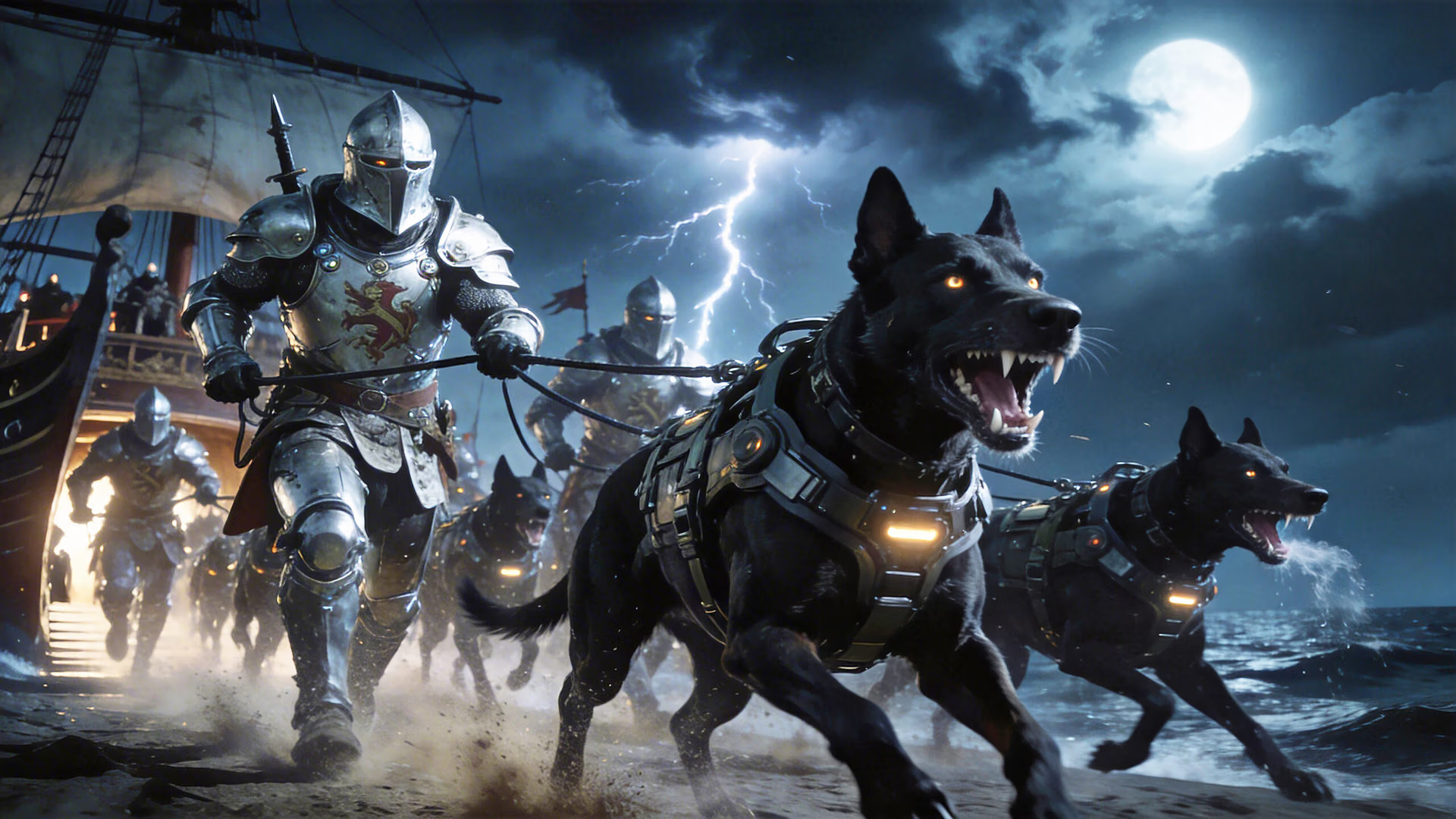
Also, I look at AI as a collaborator. My approach to AI is to be able to collaborate more easily — I already have all my characters developed in 3D, so I feed them into AI to keep the characters looking the way I designed them, while also saving money on animation. But more importantly, I’m feeding the big brain of AI our real storytelling, our real history, coming from an Indigenous Pueblo person. Someone non-native could feed the same general story to AI and it would come out completely wrong. So this is a way of growing with the technology, learning as much as I can about it, and incorporating it into the work.
You’ve been shooting segments of the feature film for years, haven’t you?
Virgil: It’s been ongoing — 24 years ago I was creating the characters, taking pictures of them or shooting on 8mm film. There were no cell phones back then, or at least no cameras in them. Now I’ll just shoot in 4K on my iPhone. The book that Charles King and I released — ReVOlution — I shot entirely on my iPhone 7 Plus down in White Sands. I have a huge vault of footage and images from places I’ve been filming since way back. In the projection room at the Vladem, you’ll see footage shot and things I’ve done collaborating with AI — all together. That mix really tells the story of the whole development
over time.
Finally, you always hear about artists saying we have to collaborate, but now you’ve actually done it. How was the process?
Eric: It’s definitely been an eye-opening experience because you’re working with a famous artist who has, throughout the years, established and morphed his style over a long period of time. You get to the point where you realize you can’t possibly replicate that. You have to create the stage. For me, it was just — you have to dive right into it. There’s really no planning, you just do it. And, embracing the technology, embracing AI — all of these tools become so important. But it’s been great. Concepting with Virgil is a back and forth — passing the hot potato. What do you think of this? Oh my god, this really fits the narrative. It’s been sort of effortless, honestly. Very natural communication.
Virgil: It’s fun to show people the behind the scenes of creating the next show. We’ve done so many shows, but we’re always learning from the last one and making it better. Bringing in someone who is creating artwork specifically for the next venue is exciting — they’re like, Oh my god, how do you do this? And I always say: don’t stress, this is what we have to do, let it flow. I’ve learned so much along the way — so many artists complain about how their work gets hung or displayed.
I learned early to speak up for yourself, collaborate with the person whose job it is to design the exhibition, and suggest ideas. Once I learned Photoshop, I could scan a room, turn it 3D, and bring samples of what it could look like to every development meeting. The venue team would say, Oh my god, this is going to look so cool. I encourage all artists to have an open mind and work with museums and venues that will understand your vision. Once you combine both visions, it becomes something better. I want to teach upcoming Indigenous artists how to collaborate with venues, because a lot of people think it’s intimidating — but like anything, once you go through it, you learn, and the shows just keep getting better.