
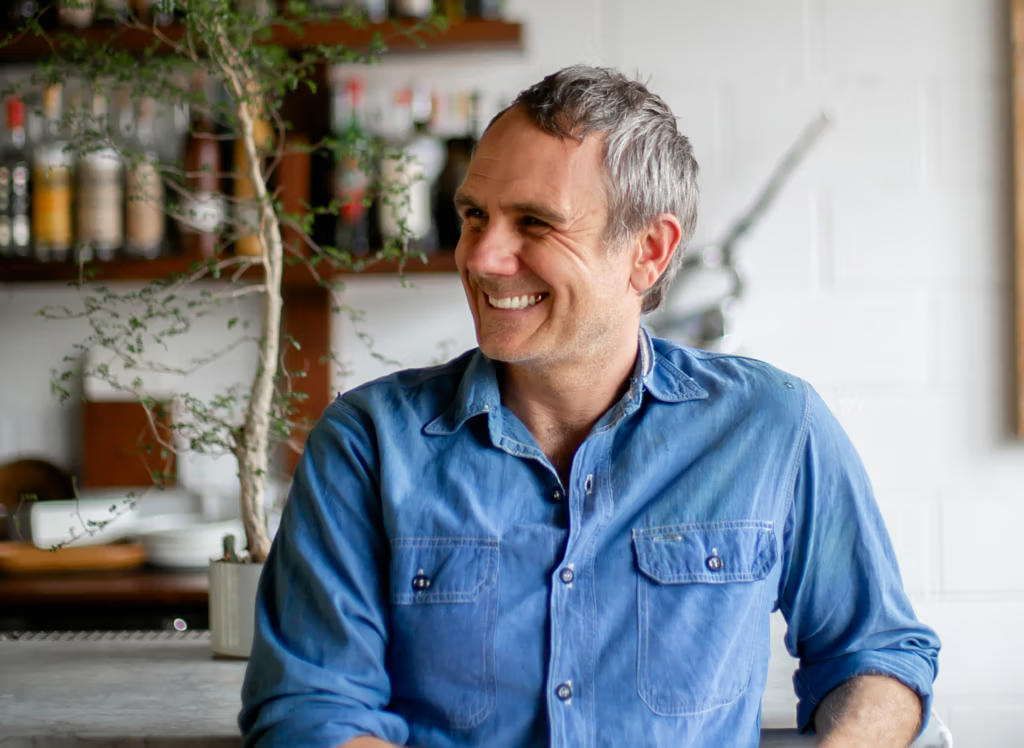
I spent a brisk, crisp forty-five minutes with Jonathan Boyd, struck by his absolute clarity — of purpose, of focus, of what good design means. Everything he cared about pointed at wood, at getting things right, at not compromising. I meant to ask about Leo’s, the restaurant he co-founded, but neither of us had the time. So one night I just went. And I realized he didn’t need to tell me anything more, because every single thing he cared about was on display, in process, manifest in that room: the same elegance of design, the same clarity, the same excellence in every detail — the menu, the drinks, the waiters, all of it. I shouldn’t have been surprised. When you master one thing, then find a second domain that rewards the same drive, you don’t just add to your success — you multiply it by an order of magnitude.
He dropped out of high school and ended up at St. John’s College, the school whose whole curriculum is the great books and whose whole promise is that it puts you on no track at all. He left St. John’s at seventeen, fell in love with adobe building, and spent three years living in a van and laying mud across the Southwest before a torn knee turned him toward furniture. Today he builds tables, weaves leather benches by hand, grows cacti under greenhouse plastic, and is a partner in Leo’s; a Santa Fe restaurant that has landed on national best-of lists. His family kept waiting for him to get a real job.
What follows is a conversation that begins with a single white-oak table and keeps widening: into wood and food and place, into where good material comes from and why it matters, and finally into the oldest question of all: whether the thing he can do with his hands is something anyone can learn, or something you either have or you don’t. Throughout, he keeps returning to one word. He resists perfectionist and artist. He’ll accept compulsive. But the word he keeps is craft. — OL
ST. JOHN’S, AND LEARNING HOW TO LEARN
So you went to St. John’s. And you dropped out of high school first — how did that happen, dropping out of high school and ending up at St. John’s?
I dropped out of high school. At the time, they didn’t ask for a GED. You write your application, you write your essay, and they let you in.
How did you like the curriculum?
I think it’s incredible. It teaches you to reflect on what it means to live a good life. It teaches you to reflect on what it means to pursue what you want. It makes you move with intention. It’s about having a thoughtful existence, having critical thinking, and — having spent so much time reading the classics — standing on the shoulders of giants, looking out. It teaches you the ability to see the world through other eyes.
Given your diverse interests, you’d say that’s a diverse education, right?
Fundamentally, like I said, it teaches you how to learn. It teaches you how to read, how to take information. So when you have interests, when you have that kind of background, it opens up doors. It lets you feel capable of tackling anything. And for me, that’s something I’ve taken into all of my pursuits: never feeling daunted. It always feels human. All of it feels human and capable. You just need to learn it and move through it.
FALLING INTO ADOBE
Tell me about your interest in woodwork, and how you got here.
I grew up in a family that never worked with their hands. Nobody in my family ever had a job that involved a screwdriver. It was a typical Jewish American immigrant family — came to New York, worked in textiles, ran factories, ran businesses. That’s my father’s side. My mother’s British, born in Devon; my grandfather was in the British Royal Navy, stationed in Bermuda.
What did they think of your interest?
They were waiting for me to get a real job. They thought it was cute. The sentiment was, Jonathan’s having a good time. He’ll figure it out. He’ll get a real job at some point and get serious about life. Nobody really understood what I was doing, or cared to, which was fine.
But you pursued it anyway.
It hasn’t been a straight path. When I left St. John’s I was going to go to the Cordon Bleu — I was all applied, in Paris, going to move there. Then I fell in love with adobe building. I worked with this amazing old-school New Mexican craftsman, and I built the plantings in the Southwest Cafe with him from the ground up. I learned New Mexico adobe building and craftsmanship: peeling vigas by hand, laying brick on sand, laying mud. I traveled the state living in my van for three years, working with him, getting my hands dirty, abusing my body.
How did you abuse your body?
If you’ve ever laid adobe for twelve hours in the sun in Santa Fe, you know. It’s just hard. I fell in love with working with this man — he was an old-school New Mexican craftsman who did everything. We worked fourteen- to sixteen-hour days, sun up to sundown. He lived way north of Taos, so he’d live on the job site and work every minute he could of every single day, because his attitude was, well, I’m here, so I’ll work. I learned the skills of building from him.
When you graduated, what did you think you were going to do when you grew up?
From an early age I was studying to be a veterinary surgeon. I worked in a specialty veterinary surgical office from the time I was fourteen until twenty. Every summer I’d go back and study with a spinal surgeon, standing there holding things open, assisting in surgeries. That was my path. Then I recognized that the work was oriented more toward people than toward surgery — maybe sixty percent of the job is dealing with people, forty percent is actually performing surgery. And the way that career works, you’re stuck in an affluent area. You build your practice, you can never go anywhere until it builds, then you become a partner. You’re rooted. It’s not like being a human surgeon.
So you diverted. Was there an aha moment? You told your family, guess what, I’m not doing that?
I didn’t know what I was doing. I fell into the adobe thing and loved it. For a while I had no idea what I was doing, so I just built for three years. Then I tore my knee hiking, couldn’t do that work anymore, and started a real estate investment company — because I figured I had to do something with my brain and not my body, temporarily. It was right in the crash. So I was doing strange, gray-area things around trading and managing.
ONE LINE, AND IT’S CRAFT
I’m interested in the convergence of adobe, wood, and food — how these diverse interests connect, and the entrepreneurial drive underneath them. How do you connect the dots?
There’s one line, and it’s craft. It’s a great appreciation for the work of your hands. That’s the through line in everything I do — whether it’s growing cactus, laying an adobe brick, hand-peeling vigas, making furniture, making food, caring about drinks. It’s care and craft.
Let’s talk about woodwork and craft. Tell me what that really means.
When I say craft, I’m speaking abstractly, about the idea of craftsmanship.
Did you make this table, or have someone do it?
My studio. Me. At this point you can’t pull me away from my studio.
It’s white oak. It’s pretty hard. I picked it aesthetically and for durability. It’s an American hardwood, extremely durable, and it lasts. It’s gorgeous. I took a sixteen-inch-wide board for the top, joined it to another board that matches beautifully, and did a mitered waterfall drop to the sides.
What does that mean, a mitered waterfall?
If you look at the side, you see that forty-five-degree cut. The grain drops and wraps down, rather than showing the end grain of the board coming up and breaking across. It’s the cleanest possible construction — very contemporary. It gives you something so clean it almost goes away. It’s more about the form than the object. There’s a spine running through the joint inside, joining the two pieces of wood; you fold it, it’s adhered, and the piece down below provides most of the structural support. That piece is a tenon — a mortise-and-tenon joint into the side — and the shoulder of it stops the table from racking side to side. Because the top is ten feet long, you’d never trust that the board wouldn’t belly over time. So by turning that piece on edge, you create both the racking strength, through the shoulder, and the stability, through the height of that ridge running down the center. That’s what keeps the top dead flat.
You’re a craftsman. Did you study with someone? Books?
Totally self-taught. I went to one class at the community college when I first started, then started a second class and dropped out because I had too many orders and was too busy.
So your love of craft, reflected in the wood — it extends to the other things you do.
It’s not that it shifts or moves. It’s the same thing. It’s caring about beauty, caring about well-made things, and wanting them executed flawlessly. This is the first public-facing project I’ve ever done. For fifteen years people appreciated the care in the furniture I made; now that we’re doing something public-facing, that care extends to the whole experience people have coming into Leo’s. I’m not taking credit for the food — our chef, Stella, drives that kitchen, and she’s amazing. And Zach is a James Beard Award–winning chef and my partner in this project. I’m not taking credit for everything you see. I’m just trying to show you the through line. And for me it’s that care. It’s what I bring to every aspect of what I do: I care about every detail, I care that it’s well made, I care that it’s beautiful, I care that it’s presented flawlessly.
So you picked the wood, the design, the finish, the idea of it — all yours. Where’s your satisfaction in the process? If I said, okay, sanding — do you like that part? What gives you the greatest satisfaction?
At this point it’s less about individual pieces. I have a team in the shop now, and we make a lot of furniture. There’s more satisfaction in making a space, because we turn out pieces all day long — they have to be perfect, they’re beautiful, there’s a sense of accomplishment — but the space is the larger thing.
PLACE, AND KEEPING THE CONCRETE BLOCK
Beyond craft, there seems to be an obsession with place, and with experience. Let’s talk about place first. How is your obsession with craft informed by where we’re sitting?
Everything. This was my workshop — my studio for almost ten years. That’s my work table; it was my run-off table for my table saw, and it sat right here. When you have a table saw, you have a table you run pieces off onto, level with the saw, so the cut stays true. It was my run-off table for the whole ten years I worked in this space. I lived and worked here — I didn’t literally sleep here, but I was here all the time.
The things I notice are minimalist, light. But the story of what it was informs what it is.
Being rooted in me, making things here, gave me a perspective on what this space could be. I spent so much time here that I knew it at all times of day — where the light comes in, where people would sit. These were my old bulldoors, so there was no question they were going to feel like carriage doors to me. That’s why I recreated what look like carriage doors, even though they’re French doors — old-fashioned New York, Brooklyn Heights carriage doors from the early 1900s, but more contemporary.
Did you build these doors?
I built them. Literally the only thing that was here was the concrete block walls, and I worked very hard to keep them. The city made me insulate the building, so I spent an extra twenty grand putting the insulation on the outside, so that when you stand in here you can still see the concrete block. There was no way we were covering it up. The other thing I kept was the original roof. It probably cost me twenty-five grand to keep that ceiling — it would have been so much easier to rip it off — but there was no way. The beams are undersized, so I had to do a crazy steel structure to make it work. But we kept the original ceiling and the original concrete.
It sounds like you don’t like to throw anything out.
Why would you, if it’s good? Returning to the theme of craft: when you build something beautifully, using honest materials, it can be reused for the next five hundred years. If this table is protected from the elements, the wood could be reused to make anything for a long, long time.
There’s a book by Stewart Brand on maintenance — it’s up your alley. The theme is knowing how to do things. We used to be able to repair our cars; we used to do things with our hands. You seem to get accumulating satisfaction from old stuff you’ve re-employed.
I grew up working on a farm. My first car was a ‘71 Volkswagen bus that I still own. My second was a ‘73 MGB that I still own. I’ve built every motor, every transmission, from the ground up. I can make them run. That’s part of what makes me go: an appreciation for keeping things alive. If they’re built right, they’ll last. But they take work, they take maintenance, they take knowledge. They’re human. They’re humanly capable of being understood. We have to be able to use the things that already exist in this world — as a matter of policy, everything from climate to actually figuring out how to live. For all of us who think we’re not in control, being able to do things yourself, the old-fashioned self-reliance, is important.
LIGHT, INSIDE AND OUTSIDE
There seems to be intense thought about light here. We’re in New Mexico, of course — but you kept that roof, and this part is all new.
Most of the year the shadecloth is up, but it’s greenhouse plastic underneath — that’s why I can grow the loofahs and the packed podiums in there. For the summer months it goes to an eighty-five-percent shadecloth that I stretch and then take off. I did a ripstop wax canvas that rolls up and down for the sides and the back. It’s a temporary, quote-unquote structure, but it’s an amazing greenhouse space. That was our solution — when we started a year ago we had thirty-six seats inside, and we quickly needed the patio. I built it in the last three months.
I assume you’d call yourself a perfectionist. You seem obsessed.
I’m compulsive. I’m not a perfectionist. I’d draw that distinction — I’m not an artist and I’m not a perfectionist, but I am compulsive, and I am a craftsman.
FOOD, THE MOST PERISHABLE CRAFT
Now the dot about food. How does that connect?
It’s probably the first thing I cared about. I started cooking pastries for a tea shop when I was twelve — it was a side hustle, making cakes for a local tea shop in Pennsylvania. Through college I lived in my van, so I didn’t have a kitchen; I worked as a private chef for people so I could cook myself meals too. I’d cook them a beautiful meal and get the leftovers. I worked as a chef on a sailboat for a year, sailing across the Atlantic. Cooking has always been my thing. And I always said I’d never ruin my passion for cooking by cooking professionally.
There’s nothing more perishable than food. It’s craft, but it also goes away. Anything to say about that?
You’re only as good as the last meal you cooked, and it’s true — you put yourself out there. When you think about a restaurant, yes, it’s about the food, but honestly, at this point in the world, it’s about the experience. It’s everything you curate that happens in the experience of being in the space and eating the food.
ALL THE WAY BACK TO THE TREE
You clearly have an obsession with material.
Being fanatical about what I do means the relationship to the material goes all the way back to the tree. I have relationships with sawyers in Pennsylvania who source sustainably from land they care about, and who care about how they deliver the wood.
It makes a big difference, doesn’t it?
The quality is incomparable. If I call up Levi, or Myron in Pennsylvania, and ask for material, they know the land they’ve been sourcing from. They’re generational families. Not all sawyers are created equal.
How do you know one from another? What distinguishes the way they produce and harvest wood?
You can tell from what they deliver, and from who they are and where they live and work. If they’re a family-run sawyer operating in the same location for generations, not buying logs from around the world but cutting from the fifty miles around them — because moving a wet log is insanely expensive and hard — then you know they’re sourcing sustainably. I don’t care if it’s certified. If they’ve been there that long and they didn’t clear-cut the land, they were doing it correctly, and they care.
Then you care about how they cut and how they dry. Drying is everything. A lot of wood gets caught in how it’s dried, and the care put into it, and how healthy the tree was — the selection of the tree, and which section they cut. I’m not a sawyer, but I know enough that when I see the product, I know. Finding a sixteen-inch-wide, two-inch-thick board of white oak to start a table is crazy — they’re just not out there at ten feet long, and it needs to be perfectly dried, or it would have turned into a potato chip. It would have cupped, twisted, been unstable. It’s a testament to the sawyer that the board comes to me flat enough to make this. And it stays flat because of the wood, not because of what I’ve done — the way I construct it lets the wood move the way it needs to, so I’m not fighting it. That’s part of good craftsmanship. But it starts with the sawyer.
I assume this obsession carries over to the way you look at food.
It’s the same thing. It’s the same care about where we source. We make all of our sauces, all of our pastes — we literally have a mortar and pestle in the back. We produce in a way that’s totally hidden. When you receive the food, you just see a beautiful plate, but the amount of practice that goes into it is astronomical. The time spent cooking while we’re open is nothing compared to the time Stella is here prepping. That’s what’s hidden, and that’s what makes it special. You know it when you taste it. Most people walk into this space with no idea — they just feel it’s good.
THE EXPERIENCE, AND THE TOILET-PAPER HOLDER
What delights or motivates you about giving people the experience?
When you pay attention to every aspect and have a cohesive voice — in design, in experience, in place — people start to see it. Some pick up on it right away. One of my favorite things in the restaurant is the toilet-paper holder in the bathroom. I spent probably sixteen hours on each one. It’s the same oak burl I used for the bar, but on the bar I made it look old, I patinated it. I don’t make things that hit people over the head. Some designers, you know it’s theirs the moment you walk in — distinctive, beautiful, wild. When people walk into a space I build, they just say, Oh, it’s nice. That’s the extent of it, and that’s what I want. When you have that cohesiveness, people feel it without knowing what they’re feeling.
So you’re an entrepreneur now.
I’ve always been entrepreneurial; it just took me time to find my path. I started the real estate investment company and hated it — made enough money to stop working it, not retire, just stop. That’s when I started making furniture. I talked to somebody about becoming a money manager, because that’s what smart people with money do, and I couldn’t do it. I’ve always shunned that.
SANTA FE, A HARD AND BEAUTIFUL PLACE
Are your parents pleased with you now? Are you getting better feedback?
They know I’m okay. They’re not worried I can support myself. When we started getting national accolades my mother could read about, she was like, Oh, look, he’s doing something. She wasn’t going to tell her friends her son opened a restaurant — that’s embarrassing. But when we made Esquire’s best new restaurants in America, that was more than just a restaurant. That was something. It turned something for her. It would be easier for her if I could just say I was a lawyer. But now she’d say, yeah, he’s successful, he’s doing something. Before, I ran a furniture business and got articles written about me, but it was never something she could tell her friends. She lived in that world a bit.
What do you like about Santa Fe?
It’s a tough place. But it’s beautiful, and hands down that’s the reason I’m here — the access to nature and the beauty. Everything else I love follows from that, and from the fact that it attracts a very unique person who wants to be here. It’s hard to get here. There’s no easy place to go from here unless you want to be in Dallas, and I don’t want to be in Dallas.
When you say beautiful, what do you mean?
The mountains, the land. I love the desert, I love the austerity of it. Over the last few weeks, seeing the prickly pear blooming, the cholla blooming — I love cacti. There’s something magical about the flowers of something so inhospitable. That encapsulates how amazing New Mexico is.
What does a hard place mean?
Isolated. Starting out as a furniture maker here, I never felt like I could really — in New York there’d be thirty other people I could talk to who were trying to do what I was doing, struggling, working. Here I didn’t find that kind of community. There are furniture makers, and I don’t mean to disparage them, but it wasn’t the same. It was isolating. I wouldn’t have opened a restaurant had I lived in New York. But so much of what your passions are is formed by experience — and the experience of living here is what drives me.
You seem determined to follow your own interests.
I’ve never been hired to do anything, and I don’t think anybody could ever hire me. I’m unemployable. I always distress people. I’ve never been fired and I’ve never been hired. I attempted briefly to work with someone, and thank God I made sure to fire myself.
What gives you satisfaction these days?
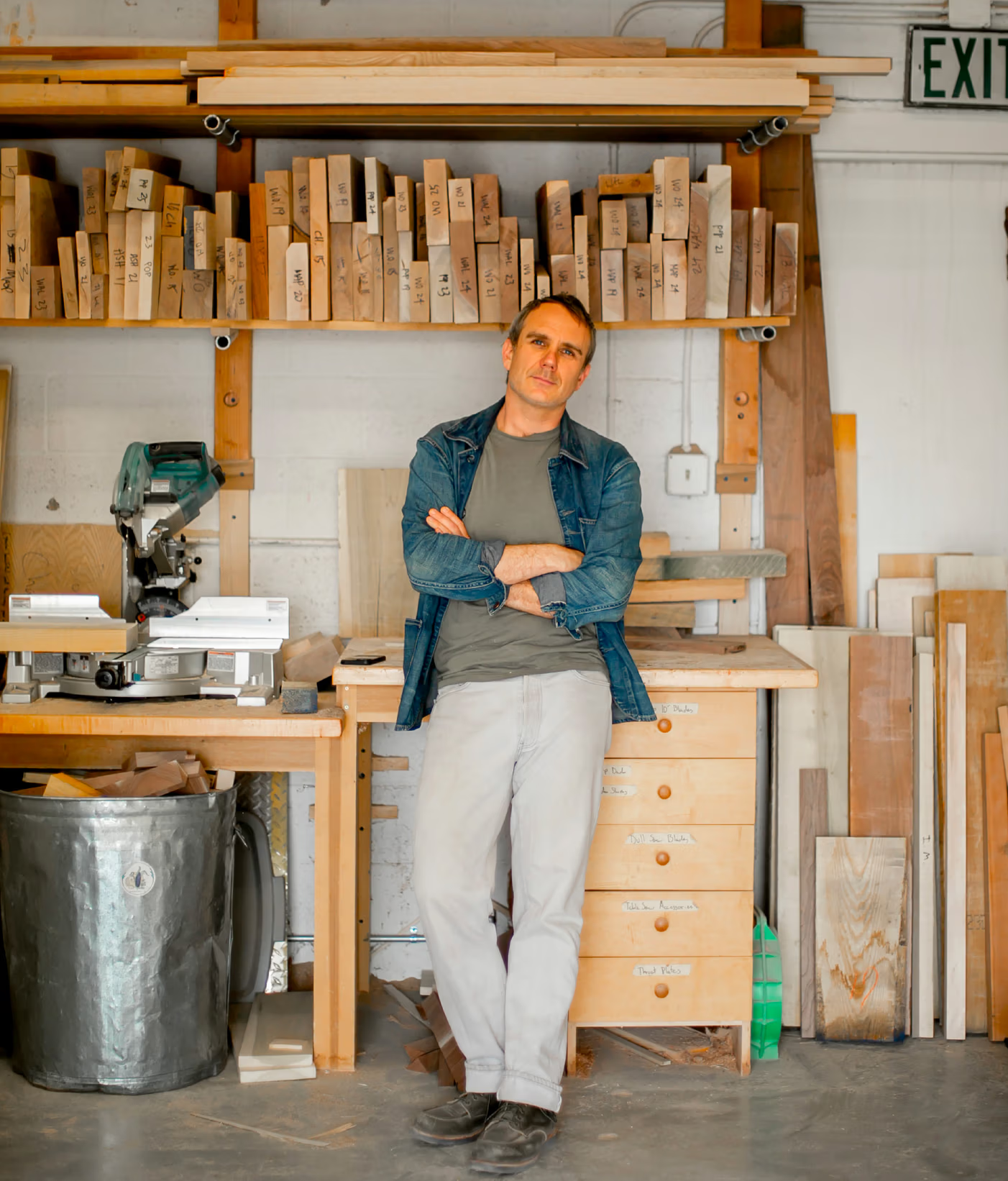
The thing I love is still making things. It’s the joke in my shop — I’ll pull a project out, a bed, and it’s my project, and I make it. I could make it in three days, but it’ll take me three weeks, because I’ll be on the phone, writing emails, running to the restaurant, going to hire an attorney for somebody who got arrested, whatever it is. The bed sits there, and then I’ll get back to the shop between two and four before another meeting and work on it for two hours, then go into the next meeting. That’s the thing that keeps me grounded: still being able to make something. I wouldn’t be content if I couldn’t work with my hands. It’s almost like the shop humors me at this point, letting me have my own project. The resources are always there. It’s not like I’ll run out of things to make.
That’s part of what I love about the restaurant world: it’s endless. Just last week we were standing here and realized a piece needed to carry the line all the way up, so I had to remake it. Three weeks ago I had old benches I didn’t like the look of, so I spent the last month hand-weaving hides into woven leather benches. That was my project, and I was passionate about it, because I love those benches.
THE THING YOU HAVE OR YOU DON’T
One of the ways the world is divided — my father had an extraordinary ability to do technical things with his hands. I find many of these things difficult. He could look at something and just understand how it worked. His son could not. You obviously have that gift and interest. But what do you say to people for whom it’s genuinely hard?
The only way I can answer is through the experience of teaching employees in the wood shop. I prefer to bring on people who know absolutely nothing. And you cannot tell whether they’re learning or whether they’re bad — not for the first twelve months, at a minimum. They could be learning or they could be bad, and you have to give them twelve months. If you don’t take that time, you can never answer the question. After twelve months, you can: are they capable, or aren’t they? But there are some people who learn from the detail up, and some who look at the top. I’m one of the latter — I can tell you exactly what’s going on, and it’s easy for me.
It’s hard for me to imagine actually doing it, even when I understand it. So you agree there are people who look at things and just know how to do them — and people who can’t?
It’s like Thucydides — the people who come to the games to sell, the people who come to watch, and the people who come to compete. There’s no judging which person, or why people come to the games. There are many reasons to be in this world and to act in it, and none is more virtuous than another. But there are paths, and if you find your innate ability, that’s what it is. It doesn’t mean you understand the world better than someone who lives it differently and sees it differently. I see it in my own way. It’s human nature that we’re not all the same. It’s not just a skill to be learned — it’s something innate about the way our brains work. Some people have it, and some people don’t.