
THERE IS SOMETHING VAGUELY IRONIC about an interview that felt jazzy — lots of improvisation, sudden changes in tonality — with a man who spent the first forty-six years of his life with very restricted hearing and didn’t know it. As a kid he was punished for not paying attention and sentenced to standing in the corner — and that, according to him, is the origin story of his right angles.
He got his hearing checked. He apparently heard birds from inside a building for the first time and thought he was Superman. When I spoke to Tony Floyd, a good friend of mine, he told me Larry is his favorite person he has ever spent time with. Tony, who photographed him for the New York Times, told me this story: as a young man in Venice Beach, Larry couldn’t hear music at all until he walked past a guitar shop and heard something. A twelve-string.
This interview was conducted by Elizabeth Hayes Christopher and Scott Christopher, who did the heavy lifting — and who are artists, extraordinary artists, really, in themselves, and artists in the way they live their lives. What struck me is that Elizabeth and Scott are united not only by being artists, but by having been struck by lightning. Literally — a bolt from the blue, on a clear day, working on a painting outside their studio. It nearly killed them. It also produced a book, Lightning Seeds, of Elizabeth’s paintings and poems. Sitting with Larry, they write, was living the light.
I am fascinated by the remarkable sensibilities that develop when someone has more of one sense than another — more seeing, more feeling — and it seems to me it informs Larry Bell’s astonishing achievement. In an artist statement he made for Madison Square Park, he says the six-by-eight glass panels corresponded to his arm span and vertical reach. And, he says — and I believe it — even their four-hundred-pound weight corresponded to what he could physically lift when I was young.
His success came early. In 1967 he was on the cover of the Beatles’ album Sgt. Pepper’s. So it’s worth trying to understand why Larry, who likes to work with both hands constantly making his art, was recognized so early — and appears, at almost eighty-seven, in what he calls his sixty-sixth year of unemployment, to be as busy as he’s ever been.
Part of it is simply this: he was lucky enough to find what interested him almost from the beginning. It was the light itself, what glass could do with it. The other part is that foggy, flabby thing people call temperament. Larry generalizes it into the four tools every artist should have: spontaneity, improvisation, intuition, and trust. When Elizabeth asked how he did it, he said: I don’t know, I just do it. Wonder, actually, is possible, if you’re willing to have that attitude.
— OL
WHY TAOS?
In 1972 I came to visit one of my closest buddies, artist Ken Price, who had landed in Taos. I had not seen him for a couple of years. Before setting off I went to the Santa Monica seafood market and bought a big salmon, put it in a chiller, and hauled my ass out to Taos, New Mexico. I had never been in a place where I was a minority. I had never been in a place that was 7,000 feet above sea level. I had never been in a place that was so endlessly beautiful. I’m constantly looking at the mountain with the light changing. The mountain has rules. It can’t be breached and it won’t let development happen. I am not a climber, I just want to look at it. Taos has allowed me to control my distractions. My kids are here and I love to go places, but I don’t want to live anywhere else.
THE EARLY YEARS
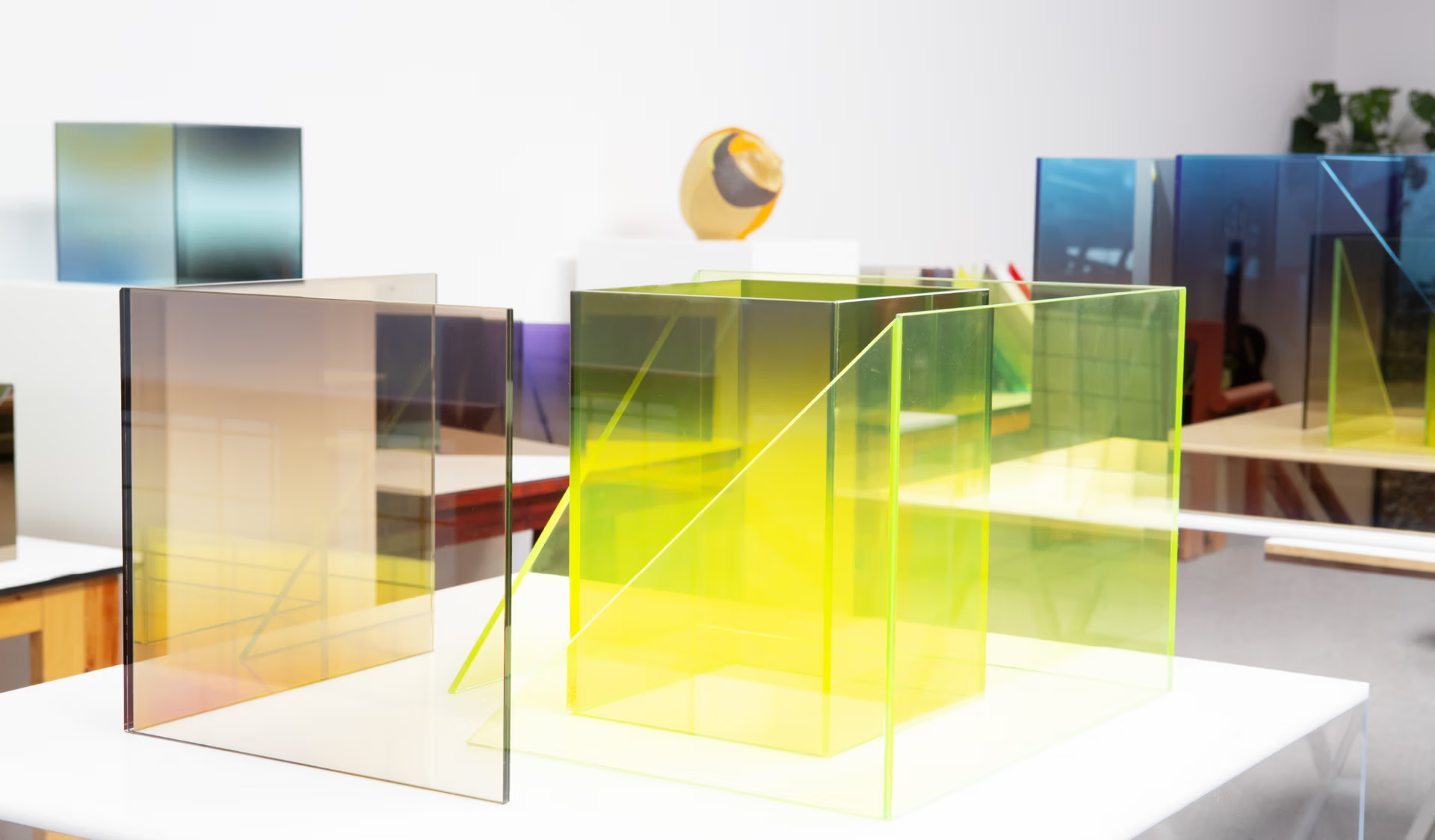
That was real early, before I knew anything about color. I was playing around with glass. Glass was great because it was cheap; you could buy it anywhere. The main thing was it reflected light, it transmitted light, and it absorbed light, all at the same time. And you could buy a piece of glass for sixty-nine cents at Thrifty drugstore. It was a material that was totally available, it was everywhere in our society, and it’s just something you don’t think very much about because you live with it all the time. I got a job in a picture framing shop where I learned to cut glass; that’s where the affection started. The guy who ran the shop was such a sweetheart. He had boxes of scraps and he let me do whatever I wanted. Then I bought some cheap mirrors at Thrifty and scraped away the silvering on the backside so the glass was clear in certain areas, in a pattern. It did a weird thing to the construction. I was making little boxes. The scraping was the clumsy part. I could not control it; I was not very happy with how the stuff came out. But it introduced me to a whole other world.
Somebody mentioned a technical process called front surface mirrors and I looked it up in the yellow pages and found somebody who made them. I went out to see him and hired him to make some patterns on a piece of glass. It was great, and I was not scraping things anymore. But he put everything on my shoulders. I was hoping for some counsel and he said, I don’t know how you’re going to mask this off, but you can’t use tape, you can’t use this, you can’t do that, because the process won’t work if you have organic materials in there — whatever that may have meant. Then the work evolved and I had a show in New York, my first one-person show. Several pieces broke in transit. We had a month or better to repair them and the show was very successful. In the process of the repairs I was introduced to another kind of mirror making. The guy was a novelty metallizer; he would mirror glass balls and they became Christmas ornaments. As it turned out it was the same process I was hiring somebody to do for me in LA.
He suggested I get into doing it myself, because he knew how much I was paying the company in LA. He said, I have equipment I’m not using, I’ll sell it to you cheap. The dealers wanted me to stay in New York, so I decided I would buy the equipment and learn how to do it — and that started it all, the coating process. He got rid of a piece of junk he had no use for and turned it into real money. I was thrilled, but I didn’t have any idea what I was getting myself into.
START ON PAGE ONE
I found a little studio on East 9th Street and the machine was moved into that small building. I did not know anything about it from one end to the other. The guy who sold it to me came in on a real blizzardy winter afternoon in a Russian hat and a bearskin coat. He was a German guy. He said, Ya, ya, this will do very nice. I said, When do I get my first lesson on how to use this thing? He says, Right now, and reaches into his pocket and pulls out a book on vacuum deposition of thin films, sticks it in my stomach, says, Start on page one, and walks out. He called me the next day and said, Don’t be mad at me, you are too enthusiastic. I’m sending a guy over and you will pay him twenty dollars a day plus cab fare. The guy showed up and explained what the book meant. He died two months later from tuberculosis and I was on my own with my book and my machine.
THE ONLY THING I BELIEVE IS THAT ART IS A TEACHER
Art is not an object. A great artist said that to me once. We were talking about what art is and so on and he said, Art is a teacher. It makes so much sense. And art never stops teaching.
SURPRISE IS PART OF THE DEAL
Light manifests itself in the surfaces that I make. Every once in a while — the black piece on the wall (Solar Study Memories #158, Collage) — I’m astonished. With that piece we were preparing the surface of the canvas for a collage and the preparation ended up being too hauntingly beautiful to mess with. So surprise is part of the deal that makes things interesting. I’ve said this I don’t know how many times, but there are four tools that an artist should have at their disposal: spontaneity, improvisation, intuition, and trust. And a good sense of humor doesn’t hurt either. I like the surprises that come out of me. We just finished a piece on the wall over there. All of those pieces are part of a new body of stuff, and I can’t figure out exactly what interests me about them. But the fact that they change as you walk by them — just keep your eye on the piece as you walk toward it and then walk toward the stairway.
LET ITS SECRETS SEEP IN
I look at that piece (Solar Study Memories #158, Collage) and I find it so astoundingly noisy, when in fact it is a very quiet, somber thing. But I made every inch of it. I didn’t know I was making it at the time. It wasn’t until we pinned it on the wall, and I was supposed to work back into it to activate something in the surface, that I realized there’s nothing to do. It’s already dancing for me. How did I do that? I better sit and look at it for a while and let its secrets seep in.
I’VE GOT MORE ACTION THAN I’VE EVER HAD IN MY LIFE
I haven’t mastered anything. It’s all luck, and depending on how good a boy you’ve been, you get to appreciate it. If you’ve not been a good boy, then you don’t appreciate it. You struggle with jealousy and other unpleasant things. I’m quite content with my activities. I like what I do. I’ve been blessed with the ability to just carry on with what I do. It’s always something about money that has to do with being able to keep going. I’ve somehow been able to keep a handle on enough money to carry on with what I want to do. Part of that has to do with the superb employees I have. One of them has been with me for forty years. I don’t know what I would do without them. I am very much obliged to the people who come in every day and do the things that have to be done to keep going and keep track of what’s going on. The amount of activity has gotten out of control. There are too many shows. There were years when nothing was going on and we still managed to hang on. Now I’ve got more action than I‘ve ever had in my life and it’s getting harder to manage it.
THEY CLOSED THAT PART OF THE EXHIBITION AT MoMA
It was vandalized. They closed the exhibition. It was just a dark space. You entered into this room and it was too dark to see anything unless you spent a lot of time in there, until your pupils dilated to catch what was going on. There were people in the room and some people were really mad. They didn’t like bumping into a wall; they couldn’t see that there was a wall there, and so they kicked holes in the sheetrock. They just didn’t like it. I presented something they did not like and they felt they had the right to be critics. So they closed the Black Room part of the 1969/1970 Spaces exhibition at MoMA. I had a glass sculpture in Abilene, Texas, and somebody was so upset with it they blew it away with a shotgun. I never went back to pick up the parts. If they didn’t like it that much, I’m staying away from there.
FIVE BAGS OF SHIT
Our band was called Five Bags of Shit. Frank Gehry was one of the musicians. Sam Francis was one of the musicians. I didn’t sing anything. I just had a twelve-string guitar. All we did was make noise and had a good time doing it. A title for an album cover was what prompted this whole thing. It was called A Bag of Shit and Five Guys.
400 OF EACH
A friend of mine, a younger artist — I liked the style he had, so I went out to buy a hat so I could feel like what I thought he felt like, because he wore a hat. I have lots of hats and guitars; 400 of each. I love the shape and sound of guitars.
THE TANK
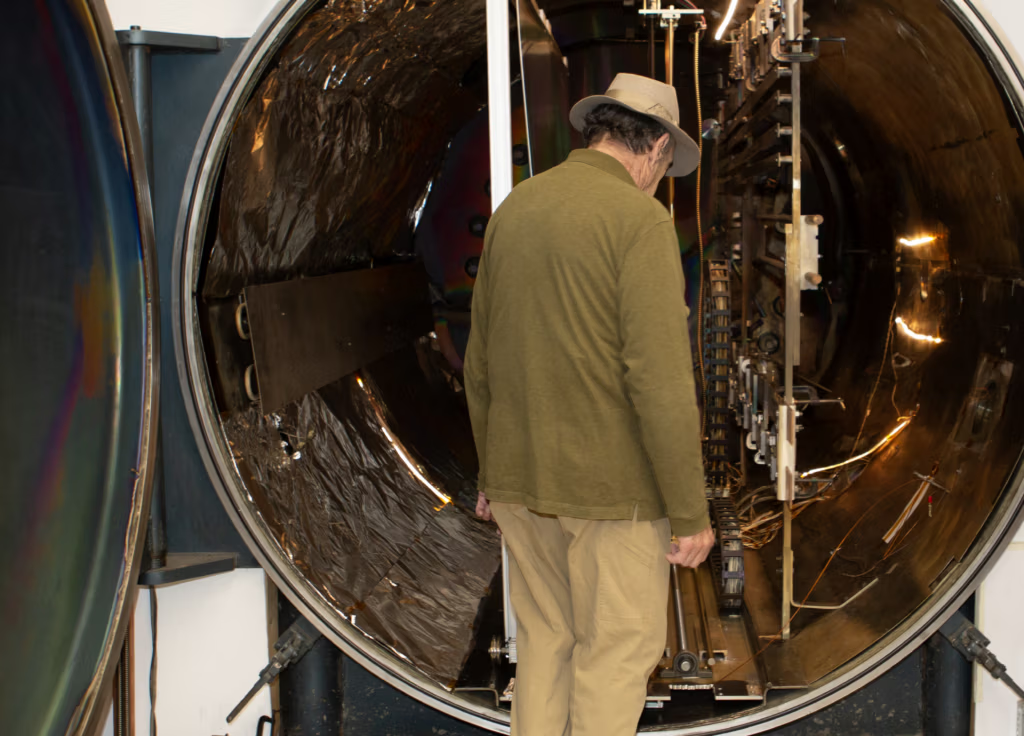
(The Tank is Bell’s vacuum-deposition chamber, the descendant of the machine he bought on East 9th Street.) The Tank enabled me to do something I would never have thought I was capable of. There was a time when I was into the coating of the surfaces. Now it is still that, but the surfaces are different. All of the things you see on paper, on canvas, or whatever — those are thin films put down by the Tank.
NEW YORK
I think New York is fantastic. But I couldn’t live there anymore. I lived there in the mid-sixties for two years. I went there from Venice Beach because I had a show and it was successful. I thought I’d stay and take advantage of it, but after about two years I just missed the proximity to the water and the fact that the air is ionized when you’re right there on the beach. All my studios there have been within a block of the ocean.
GET YOUR DAMN EARS CHECKED!
How do you know you can’t hear? Life was what it was. When I got the hearing aids it was because I was at a party and the hostess was really mad at me. She said, If I have to hear you say what again, you can’t come here for dinner anymore. Get your damn ears checked. So I went and had my ears checked at the hearing clinic. The doctor said, You don’t have a slight hearing loss, you have a profound loss. You have never heard any better than you do right now. It won’t get any better and it definitely can get worse. About the only thing you can do is get hearing aids. I remember being in the office where the person put them in my ears. I heard for the first time birds in trees from inside a building, and a hissing sound, which is the sound tires make. I had never heard these sounds before and I thought I was Superman. After a while I could hear people talking across the room.
AGNES MARTIN: I LIKED HER A LOT
We used to have lunch. I knew Agnes very well. She was funny. Oh god, yeah. So funny. She liked to be around artists. She didn’t like a certain kind of artist — ones who wanted her advice on how to get an art gallery. She didn’t like being hit on for stuff like that. She said to me once, I don’t want to meet these young people. All they want to know is how to get a gallery. What do I know about that? She talked about goofy stuff. She had a very weird sense of humor, and I liked her a lot. She actually bought a piece of mine. And she gave it to the New Mexico Museum of Art, I think… I know she bought a piece. I don’t know what she did with it.
GEORGIA O’KEEFFE: THE ORANGE BREAD WAS DELICIOUS
Before I moved here I had a girlfriend in LA who was writing her doctoral thesis on O’Keeffe’s work. She desperately wanted to talk to O’Keeffe about some of the symbolism in the paintings and what it meant. She couldn’t make contact with her. Well, I knew a collector in Los Angeles who knew O’Keeffe, and I asked my friend, how does one get hold of her? A good person really wants to talk. And she said, tell your friend to send her a recipe. So she did that. About ten days later she got a note from O’Keeffe saying, The orange bread was delicious. Be here at 3 pm. And that was it. So we flew from LA to Albuquerque, rented a car, and went to Abiquiu. She did not like being disturbed and people coming, and she did not like herself for saying okay come.
86,000 PEOPLE A DAY
(On Improvisations in the Park, Madison Square Park, New York.) That was a real epiphany. I had put pieces outside before but always in very minimal
settings. I never put them on a lawn with trees, squirrels, leaves and shadows. When I was offered the show, I was familiar with the park but I went back and looked at it and realized I didn’t have the slightest idea how to utilize the space. They wanted me, and when they told me something like 86,000 people a day passed through, around, or used the park in some manner, I decided to do it. I told the conservancy that takes care of the park that I had the work but they had to engineer the grounds, they had to choose which piece goes in which area, they had to do all of that stuff, because I didn’t have the slightest idea where to begin. And they did a magnificent job. I still get letters from people. And the New York Times gave me two color pages. I mean, come on!
I DON’T LIKE DOWNERS
As I get older I am less patient with myself. No, I’m not aspiring to do anything except finish it out feeling reasonably good. I don’t let much disturb me. Except the world situation and politics, about every aspect of it is totally unacceptable to me, to my feelings, and I don’t know how to deal with it. It’s getting particularly gnarly. I don’t like having negative feelings on things. They are downers and I don’t like downers.
I DON’T KNOW HOW I DO IT, I JUST DO IT
How do you balance the almost-scientific precision of what you do with the surprise and flexibility of intuition?
I don’t know how I do it, I just do it. I think art is about feeling. You engage by your feelings with things.
When you have a show, do you have fun watching how people react?
Yeah. I like it. And some don’t think it’s worth seeing in the first place. That’s the deal.
You’ve talked about how an artwork has internal energy that becomes unlocked by the person perceiving it.
A lot of people don’t like that feeling. I happen to like it, and it surprises me when it comes from my work. When it comes from somebody else’s work I’m not surprised, because everything is different. The feelings.
BITE-SIZED WISDOM
I’m a junkie. It’s as simple as that. If I can’t do this stuff (referring to creating) I go through withdrawals. / The work is your teacher. That’s the bottom line. / If there is no light you can’t see anything. Light is always everywhere at once, just like time. / Every day is an opportunity to be refreshed by things that happen. You have to let them happen. / The shelf life of a piece of glass is about 3 million years. Once you take it off the shelf, all bets are off.