
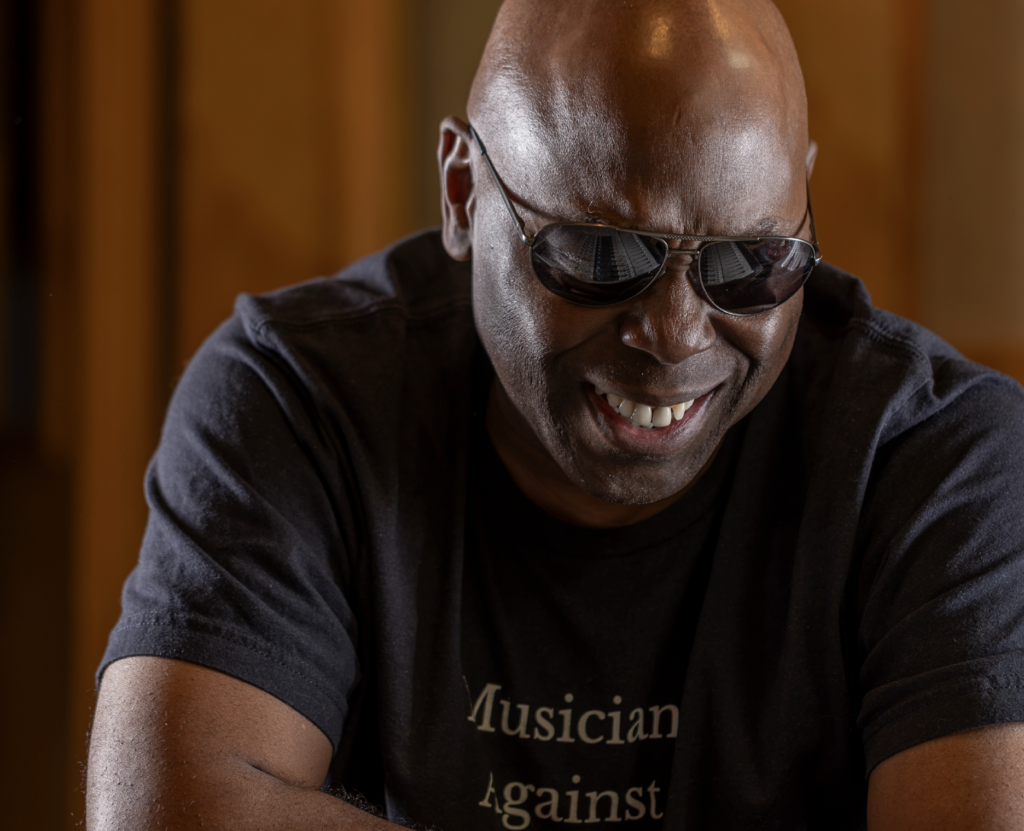
I HAVE KNOWN THE PUBLIC ENEMY BASS PLAYER and band leader and founder of Freedom Band, Brian Hardgroove, as a Santa Fean since around 2007, when we both spoke on a panel in support of independent media and locally owned businesses. This June I invited him to speak on politics, culture, and social impact at the Social Venture Network Global Gathering in Santa Fe. What follows is two friends talking about why music has a critical role to play right now.
— Vicki Pozzebon
The world knows you as a member of Public Enemy. Here you’re a local, and you’ve been unusually accessible.
Access to the spotlight came to me later in life than it does for a lot of people, for a lot of celebrities. I was an adult by the time that happened. So I knew what arrogance was. I knew what traps not to fall into. If you’re on social media, all these celebrities stepping out of these vehicles and all these people trying to get an autograph or a photograph. And there are folks who are doing that who can’t wait to be in that situation, you know? Then there are folks who understand it’s a luxury in your business for people to give a shit who you are. I developed enough as an adult before those accolades came, where I realized how to behave. Now, I’m not accessible to everybody. Talking to you, you talk to me like Brian. A lot of people here in town talk to me as the bass player of Public Enemy. And that’s a very limited conversation.
You’re so engaged in social justice issues and have been throughout your life. Yet, you don’t use the word activist.
The word activist, I don’t use. And I don’t use it because most of us are put in a position where we have to fight against something that’s wrong. What we’re fighting for is normal. But words have power, and they have deeper psychological power than they do on the surface.
I remember being on one of the radio shows here in town. And I said, Hey, look, I’m on the menu. And the interviewer was very moved, hurt, and touched by that. Okay, well, that’s all well and good, but it didn’t change the fact that I am — more so than anybody else who was sitting in that room when I said it, because I’m the one who looks like me. And I am on the menu.
How did you get to Public Enemy?
I joined my first band at 20 years old, playing CBGB, which allowed me to get into the scene in New York. I met one of Chuck D’s artists from his label, Kyle Jason, who I actually brought to Santa Fe in 2016. We played on the Plaza together. That’s how I met Chuck. Somewhere around 1999–2000, Chuck asked me to join and take them to a whole other level of what they were doing. I was a huge fan of Public Enemy. And he asked me to be the bass player and the band leader. They didn’t have a band. It was just a DJ. Now they’re known as a really powerful act with a live band. That was my responsibility to make that happen. And I did.
Does Public Enemy’s message still work, in this political climate, in front of those crowds?
The audience that Public Enemy had when they became big was an audience that was really focused on the issues that were affecting Black people at the time. And a lot of white people didn’t really resonate with it, because the band was presented as anti-white in some circles. Fight the Power is the song everyone knows, so now I think it’s clear that over time people realized that the music wasn’t Black versus white, it was us versus them. And us is everybody who doesn’t have power, and them are the people who are exploiting us with their power. Playing in front of a Megadeth audience in Ohio a couple months ago — that wouldn’t have been necessarily a perfect match ten years ago. But I think that audience now recognizes, Hey, this message that these guys have is for all of us. Everybody realizes the bullshit that’s going on. And Public Enemy is always speaking to that, along with the racism. So it resonates very well now.
And it’s very smart for Guns N’ Roses to have Public Enemy out, because those guys have to know that certainly some of their audience are MAGA people. But if Guns N’ Roses themselves were like that, we would never be on that bill. So the smart thing for them is that Public Enemy’s out there sayin’ the shit that they won’t say. But it gives them good cover down the line. That, Hey, we presented this message. And they don’t have to lose any fans. You know, let Public Enemy do the work. It’s good for Public Enemy to do it because it’s a larger audience than Public Enemy has had access to over the years.
Tell me about Freedom Band.
It was an older project that Johnny Juice, the DJ for Public Enemy, asked me to participate in. It was him and a bass player named Kevin and DMC from Run-DMC. We’d recorded a song called I’m On Your Side, the rough version of it, over a year prior. And DMC said, Man, we gotta get that out. I wrote the hook and the chorus in Estonia 20 years ago. It sounded like the lyrics were written yesterday. And that’s unfortunate, because the same bullshit keeps happening. That song is about that.
Why did you choose to be rooted in Santa Fe?
When it was time for my daughter to go to school, I didn’t want her going through the New York City school system. I had already done that. My wife’s father lived here in Santa Fe. There was a Waldorf opening here. So that determined why we moved here.
In 21 years here you’ve been honored by the city and the state. What does that mean to you?
It means to me that the world is really screwed up. Because, you know, the things I advocate for are just normalcy. And the fact that it gets upheld in these great things shows just how problematic things are, and that what I’m doing has to be done. So I appreciate the recognition, but I can only hope that it inspires other people to do the same or something similar. The two days of Brian Hardgroove Day, for the state and for the city — that’s great, because I’m sharing my access with local artists and students. But the social work, those things, I take no joy in having to do those things. But, like I said, I’m on the menu, and a lot of people are, including my daughter. So these things have to be done. And that’s unfortunate, but I’m glad to be alive to do my part.
What are you doing here now?
Well, for the last two years, I’ve spent so much time out of this state that I have to reactivate to what’s going on. I just heard today that there’s something going on across town regarding immigration issues at one of the local music venues. So I offered the band Nosotros that I’ll come in and play drums. I’m more than happy to go and play and support them. Because that’s what has to be done. When other people do them, I want to be there to support them.
How does New Mexico play into your creative life?
It’s a different environment. When I moved here, it gave me another look at the country. I come from an extremely diverse region, an extremely versatile city: New York City. New York was very, very intense with its diversity. And that’s all I ever knew growing up. So moving this far away from that was a lot less diverse. Generally, things are so much slower outside of New York that it took some getting used to. But it allowed me to then see parts of the country in ways that I would have never seen had I not left New York.
You’ve just recorded a spoken-word protest song with Ben Cohen of Ben & Jerry’s. How did that come about?
I met Ben in a Zoom meeting when I was asked to speak at the Social Venture Network Global Gathering in Santa Fe this past June. Ben is one of the founders of that organization, and I realized he was from Merrick, Long Island, and that’s just a couple of miles from me. And so when we started speaking, I’m like, Oh, I recognize this guy. It’s like talking to the older brother of some of the guys I went to school with. I realized all the things he was doing, the fight he was fighting against the corporate nonsense of Magnum and Unilever [editor’s note: Magnum and Unilever are the corporations that now own Ben & Jerry’s and are dismantling the original social mission of the ice cream company’s founding], and then his very vocal approach to social justice. I said to him in that meeting, You know, you’re fighting this fight alone, and you shouldn’t be. There’s nobody from the music world behind him. And successful fights of that nature usually have my community behind them in some way. And I said, Let’s figure out a way to do something together. It’s not just one song, which is called I’d Pledge to That. We’ve recorded five other vocal pieces that I’m gonna be doing music for. I go up to Burlington, Vermont to record them.
He writes the lyrics and does the vocal performances. We both own it, and so we can control where it goes. What you have to do is put two well-meaning visions together and then see where the universe takes it.
After decades of making music that’s meant to challenge the status quo, what still pisses you off? And what still gives you hope?
Humanity, as a thing, gives me hope. Humans can do amazing things. Humans can be beautiful, do great things, and treat each other well. So I always have hope for that, that humans are not born evil. They behave evilly based on conditioning, generally speaking. So there’s hope there. What pisses me off is that there are aggressive actions to put systems in place so that when those kids get to a point where they’re in school or getting training, they’re being trained to be assholes. That’s what pisses me off. And a lot of that comes from some aspects of our education system, some aspects of religious training where people put themselves as better than someone else. Those things piss me off, and people are not willing to address those things, because they keep creating problems that we should have passed a long time ago. Particularly in America, when there are so many different people here.
The country’s referred to as an experiment, which I never liked. What are we experimenting to find out? Because what they’re trying to prove is that, well, these people are better than those people. But the reality is everyone’s not the same. And that is what is beautiful about this country. People have different points of view, different cultural biases, but in this country, at least on the books, if you’re from two different countries that border each other, and over there you guys are always fighting each other — okay, that’s something that we can’t control from here, to a degree. But the law says, when you get here, you leave each other alone. You don’t have to like each other, but you leave each other alone. That’s what the law says in America. But that’s not how we behave here. On the books, this country says the right things, but we have too many people in power who try to do something else. And that pisses me off.
You’re wearing a MAGA T-shirt. You want to tell me about that?
Yeah. I like to go through the airports with this one. One guy actually came up to me and said, I like that MAGA. So, this says Musicians Against Gutting America. It’s an organization I came up with, and it’s basically a holding space for musicians who want to create art that addresses these issues. I would like to see more activity here at home in Santa Fe — more activity from musicians. Music can penetrate anything and anybody. And so I would like to see much more activity addressing social issues come out of Santa Fe, because Santa Fe is basically a blinking light. It’s on 24 hours a day. Everybody knows it exists, and they know it’s an art town. So anything that comes out of Santa Fe is gonna be viewed as special. Got to take advantage of that. Like, there used to be an advantage coming from New York. But it’s so saturated now that it would have to die out and come back. Santa Fe still has that, Wow, it’s an art town. Anything that comes out of here can sound just like it came from Texas or New York, but it’s gonna be listened to differently because of the name Santa Fe. And I would like to see artists understand that and utilize that.
Like I’ve said, the ONLY reason — and I mean the only, capital O, capital N, capital L, capital Y — the only reason I do music professionally is because of the power of the discipline to move the dial. Other than that, I’m just an average music lover like anybody else. But the reason I do it professionally is because of what it can do. So there are great musicians here in town, but who cares? For me, when I say, who cares? I don’t care. If the power of that talent is not moving the dial at a time like this… right now… then it’s useless to me. I couldn’t care less. And quote me on that.
SUBSCRIBE TO SANTA FE MAGAZINE HERE!
PHOTO GABRIELLA MARKS