
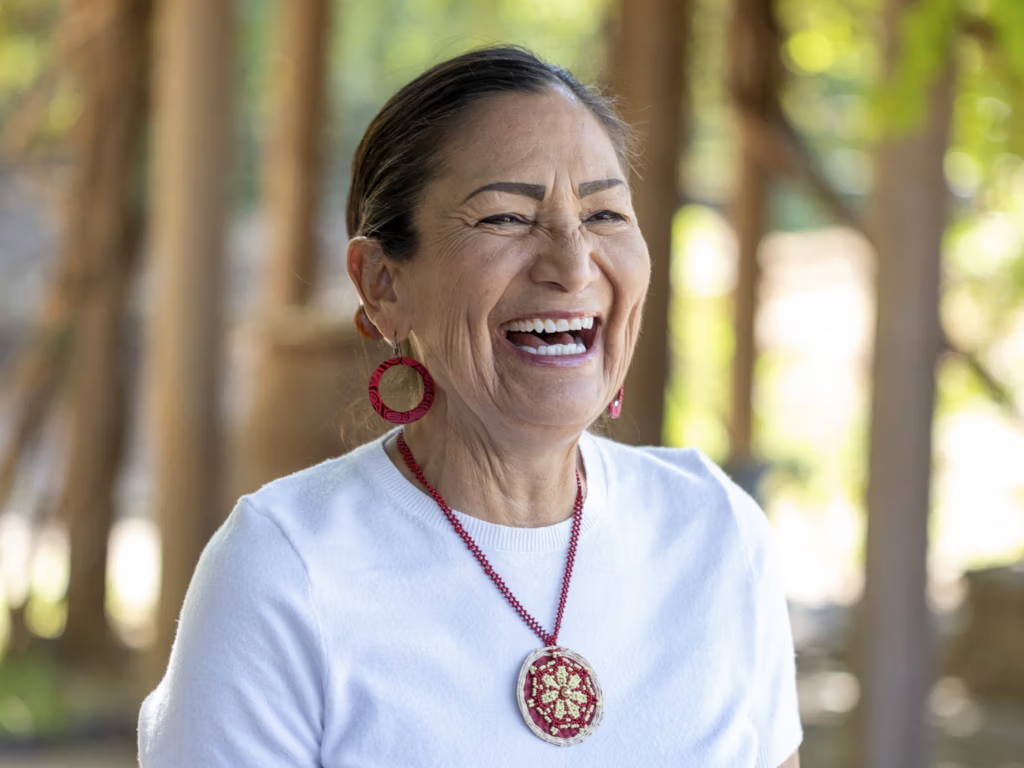
WE CAUGHT UP WITH DEB HAALAND for thirty minutes on the campaign trail early in the fall, sitting at a picnic table at Bike In Coffee in Albuquerque. She was relaxed and down-to-earth, given what this election could make her: the first Native American governor in the United States.
— Cecile Lipworth
On being the first.
Since I show up as myself every time. I’m a Pueblo woman. I’m the daughter of a military officer who started out as an enlisted man. I’m the daughter of a 25-year BIA career civil servant. The granddaughter of two people who were survivors of the boarding schools, of the assimilation policies this country forced upon Native Americans. I’m proud to be the first, because then I won’t be the last.
On what her grandfather left her.
My grandfather always believed that things were possible. He was undaunted in his belief in himself and our people, that we could accomplish anything we wanted to.
On what power looks like for her.
Nobody accomplishes anything alone. Power, for me, is finding a team that believes in the same vision for New Mexico. People who want children to read sooner, who want everyone to have health care, to feel safe in their neighborhoods, who really believe that every New Mexican should be able to pay rent and buy groceries in the same month. There are something like 50 million stones in Pueblo Bonito at Chaco Canyon. One person didn’t do that. It was a community effort that went on for hundreds of years.
On what financial insecurity and recovery taught her that politics couldn’t.
Recognizing that you’re a dysfunctional human and working to remedy that in your life is really freeing. I’m probably still a little dysfunctional. Aren’t we all? But I recognize it now. Before, I was oblivious, or I was in denial. It’s freeing to understand yourself fully — all of your flaws.
On New Mexico’s $74 billion in permanent funds, and how to use it.
We have the resources to invest in our communities. We need to create funds for things. New Mexico has a shortage of 58,000 affordable homes. Fifty-eight thousand homes. It doesn’t seem like a lot to draw from the $72 billion fund we have. In Roy, New Mexico, the kids told me when I went to visit: Our teachers have to live in travel trailers because they don’t have housing. So the teachers don’t stay around very long. That concerns me. Our students’ education is being stifled by the simple fact that we don’t have enough housing. The legislature created a Medicaid trust fund to fill in the gaps for the folks who will lose their Medicaid when the Trump cuts come into play on January 1st.
On what she’s thankful Governor Lujan Grisham did.
I told the governor how grateful I am for universal childcare and early childhood education. I had to clean my kids’ preschool so I could afford tuition. Education was important to me as a mother.
On keeping young people in New Mexico.
We bring trades back to our public schools in a big way. Career pathways in middle school, hands-on training in high school, and paid apprenticeships after graduation. I encouraged my child to go to college right after high school, and Somáh did that, graduating from UNM with a degree in theater. Not every child wants a four-year college degree. Also, my Every Child Outdoors initiative’s outdoor learning is beneficial to children in every way, and we should be inspiring our next generation of land stewards. I didn’t start college till I was twenty-eight, because no one told me to go to college.
On what holds New Mexicans together.
Our culture, our tradition, and our history. The acequia system, the landscapes, the cottonwood trees that are 500 years old; all of it is here welcoming you to this place. I describe myself as a 35th-generation New Mexican. My ancestors migrated to the Rio Grande Valley in the late 1200s. When you sit down to a plate of enchiladas, that’s a plate of heritage 1,000 years in the making. It permeates the air.
On the New Mexican, living or dead, she’d most like to sit down with.
Dennis Chávez. When I was Secretary of the Interior, I gave the Chávez lecture at the UNM law school on environmental justice as a civil rights issue, so I read a lot about him. I was amazed at how similar our people’s upbringings were. He was the first Hispanic and first New Mexican to serve a full term in the U.S. Senate, and I’m sure it wasn’t easy. And Miguel Trujillo, who sued the state of New Mexico so Native Americans could vote in state elections. I would ask where he found the courage.
Santa Fe Magazine has asked the campaign for a longer sit-down after the election. We’ll be back.