
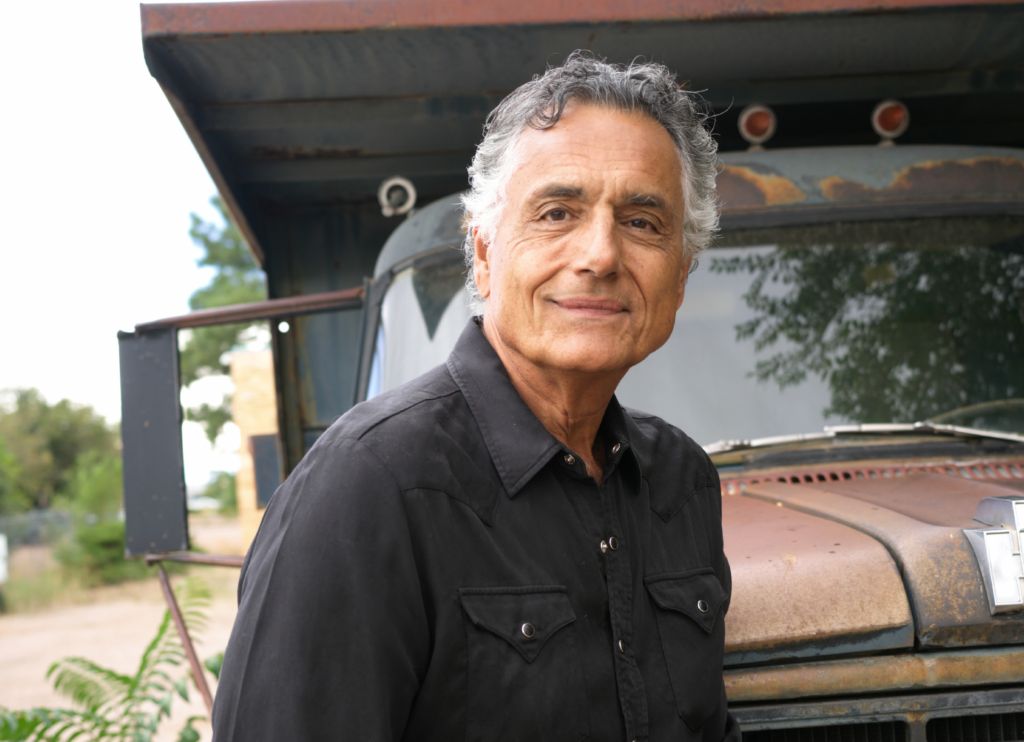
I HAVE NOTICED, over the years, that dogs and their owners end up looking alike. I can’t explain the phenomenon and I won’t try. But here is another one: over time, people who create businesses and the businesses themselves come to look the same.
David Perez saw a gap. A state that pumps as much oil as Norway, with $74 billion in the bank and two national laboratories, kept losing its best companies to Austin and Seattle because there was nowhere for them to grow. His answer was the New Mexico Innovation Hub on the campus at Midtown where the weeds grew for eight years — a place where a fusion company, a quantum-sensing startup, a community-college machine shop and a real estate developer from New York could all land in one spot and bump into each other. It was David who saw the need, and David who brought them in.
Look at David himself and he is a hub. He is constantly connecting people; it is, by his own description, the thing he does, and he has always done it, in his business and in his personal life. He calls it curiosity. He has a gift for the obvious question — why isn’t this here? — and he keeps asking it. Hence my theory. A hub is a place things pass through on their way somewhere else. What passes through David is what comes next.
Which brings me to Hamlet’s Perchance to Dream. David is always moving, and a certain part of him is in uninterrupted channeling of what’s next — he dreams, for a moment, and then he’s on to building it. That’s what I wanted to touch, and it’s the most important thing here, because we would all like to know what makes a founder get up in the morning.
So I went back to him with one question. It’s 2036. Drive in. What do you see? The rest is his answer, and at the end, his father.
— OL
IMAGINE
You teared up when you were talking about 2036. I want the picture, not the summary. If we put you there — what do you imagine?
Someone asked me about two days ago and I teared up again. I guess it’s the dream realized. I’m realizing this dream today; it’s a reality, it’s no longer a dream. But in 2036, I imagine Santa Fe Midtown, where the Innovation Hub is, is no longer weeds. You drive in.
Okay. You drive in.
You know what? The roads are perfectly smooth. They’re the best roads in New Mexico. And the parking lot has a hundred vehicles in it, and there’s four hundred people working in these labs and offices. In 2036 we’ve got two of the leading fusion energy companies doing the breakthrough work to create fusion energy — for people who don’t know what fusion energy is, fusion energy is the energy of the sun. Zero carbon.
Is that solar?
No, it’s a form of nuclear energy — fusion, not fission. So we have two companies that have made the breakthroughs in fusion energy, and a company’s gone public for a multibillion-dollar valuation. Started here.
Are they still here?
They’re here now.
You’re saying hi, David — and you’re looking at what?
This is Koichi Masuda, who has Liberty Fusion, and he has created the breakthrough that will allow fusion energy to become a reality. Since the 1940s it’s been a science experiment. We also have — we’ve already trained four hundred students who were students here in Santa Fe, and they haven’t left the state. They’ve actually stayed here, and they have jobs that are paying them a couple hundred thousand dollars a year. They’re CEOs, they’re founders.
Do you imagine these companies, the ones that become more successful, staying here? Or is this the garage — the existential garage, the garage Apple started in?
Yes. They need to be able to grow and thrive and stay in New Mexico. That’s the key, because in the past, any company that was successful often left. So the vision is that our kids, the kids that are graduating from Prep, some of them go away to college, but they come back because they get recruited back here to be the chief marketing officer of XYZ Company.
Give me some other parts of the ecosystem. That’s one company.
Another part of the dream is that we have a thriving training facility, so that even kids who are not going to college can train on all these advanced instruments and advanced machines and learn brand-new technical skills that really haven’t been anywhere else. And they get to stay here and raise their family here. That’s my dream.
And the housing?
The housing’s there too.
THE NEW COLLAR
So these are people who learn technical skills. They work advanced machinery — part of what these startups need. Give me an example.
An aerospace company creating components for satellites. They have to be made of special alloys and metals that survive space. Those can be made out of printed metal — 3D additive manufacturing out of metal. They can be tested on site. And we have this unique talent here — people with specific abilities in these areas.
If they weren’t doing this, they’d be doing what?
Maybe they were an electrician or a plumber or a furniture maker.
So for basic, skill-based people, the next level up. And in this case it would be a whole different level.
There’s a term — the new-collar workforce. The new-collar economy. Not blue collar, not white collar.
Is that commonly used?
Actually, the woman who created it runs our fabrication lab at the Hub.
Are these offices being used to train, or to actually make these parts?
Both. In the old tennis building, the old Shellaberger Tennis Center, we have Santa Fe Community College training machinists and people working on 3D — it’s called additive manufacturing.
THE GAP
You said fill the gap, solve a problem. What is it that you do that’s unique?
Not unique. But the ability — I’m super curious. I ask a lot of questions, I enjoy learning, and through that I just naturally see the gap, where the problem is, and I’m able to come up with a solution. That’s just everyday life. It’s maybe part of the downside of being a perfectionist: I see, okay, this is wrong, that’s knocked over, and it should be like that.
Small and large. And I mean this frankly — do you see what’s wrong, or do you see what’s missing? Because they aren’t always the same skill. What’s wrong refers to something that exists; what’s missing is the gap.
That’s what turns me on: being curious and looking for where there’s a problem. That’s an entrepreneurial instinct, right? See a gap, fill the gap. What people aren’t getting. You started this magazine because there was a gap.
Whatever you call it — what I would read, what I need, why isn’t there something like this? Help me out, because I just don’t get it. I must be missing something.
I think you and I have a similar thing, which is: I can’t fucking believe this isn’t happening! I think about that with Midtown. Why hasn’t this been figured out?
A CITY WITHIN A CITY
What’s the role of the apartments?
The whole thing — we’re building —
Who’s we?
Me, Phillip, Gay. And the city. Here’s the opportunity. It’s a once-in-a-lifetime, once-in-a-generation opportunity to build a city within a city. That’s what we’re doing. Because there are 62 acres in the center of Santa Fe that were a campus, so there’s a vibe to that, there’s a layout to that; some of that works, some of that needs to be changed. And now the city has a vision and a master plan for this urban, pedestrian, dense environment. Density’s good. Like New York.
You’re preaching to the converted. And the residential?
Phillip opened ArtHouse September 1st, and it’s fifty percent leased. Today’s September 25th.
That’s amazing. I want to ask you about having a partner — a partner in crime, in practice. With Phillip Gesue and with Gay Dillingham. What has it meant to have partners? Some entrepreneurs are solo.
I love having collaborators and partners. The nature of my work, which has been wholly entrepreneurial, is there’s no one thing. I’ve worked by myself at my desk for years, doing consulting and other things. Also, Gay and I are not only married, but we are great business partners. We’re doing a lot of stuff together.
What’s it like to work with your wife?
We do really well together, and we know where we need to diverge. Gay’s thing is film and television, that whole world of production, and I’m happy to go along; we spend a lot of time together on it. The Innovation Hub is my complete focus and Gay’s a partner in that, but I’m the guy taking charge; it’s my thing every single day. And we share a lot in the hot tub. That’s our boardroom.
I’m sure it isn’t always wonderful. I’m sure you have fights.
Oh, yeah, we have major disagreements, and we talk through things, because we’re really different.
And Phillip?
Great admiration and respect and fondness for Phillip, because we couldn’t do this project without him. I’m not a real estate developer. This is a huge real estate development project — ultimately it’s going to be a fifty, sixty, seventy-million-dollar project. And Phillip has been there and done that on the real estate development side for thirty-five years.
A co-founder is the person you couldn’t have done it without.
Phillip and Gay. And me. I’m having the time of my life — because of the project, and the impact, and the place we’re getting to play in, and my partners. And then we’ve got a dozen other partners and institutions all over the state.
You’re not just creating a hub. You are a hub. Personally. And the entity you’re trying to create is that. Am I wrong?
I think you’re absolutely right. And I think this is part of the magic of New Mexico, because we’re such a small community, a close community, open to meeting and being introduced, that you’re half a phone call or a text away from meeting basically anybody in the state. And Gay and I are doubled down on New Mexico and tripled down on Santa Fe. We have a unique moment in time to change the trajectory of our state, and improve it, and grow, and give a lot of people opportunities that have never been in the state before, to build a real career and pay for their own lives.
It’s a hinge. A pivotal moment.
It’s pivotal. And we’re not selling square footage. We’re selling community. That’s why a lot of these people are already here. They don’t want to be alone in a building somewhere off the street. They want to be part of the community.
SKIN IN THE GAME
You bet your own money. All three partners decided to put in your own money. Was there a moment at the metaphorical kitchen table where you said, we’re doing this with our own money — and why do we have to bet our own money?
I can’t, in this moment, think of the moment. There were certainly a lot of conversations. This is from conversations with hundreds and hundreds of people in the state of New Mexico over several years, asking a lot of questions — why, why not? — and figuring out, okay, this is really what’s missing and can really pull together the economy. And then we got a grant from the state. So, yippee, I can get paid!
Do you believe people who ask other people for money should have skin in the game?
Look, if you’re an entrepreneur, you have skin in the game. I’m sure you have to: spend years burning savings, not getting paid for anything, building a business. Years. There’s other people who are looking for a job. That’s skin in the game.
What does it take?
It’s that, and something else. You have no authority as an entrepreneur. You’re always selling something — you have to sell a vision. If you’re asking people for money and you don’t have conviction, you’re not in it. You are betting on something, and we’re all in — pocketbook, heart and soul. And it’s the only way to live. And do you know what’s been great? The community has responded. Organizations and institutions and companies are showing up and putting money on the table through sponsorships, through leases.
THE MOTOR CLUB
We’re still on the trip. It’s lunch. Do you go out to eat?
Today, in 2026, there’s Tender Fire Kitchen, one restaurant — breakfast, lunch, dinner — and Coffee, which has pastries. Then fast-forward: ten years later, you and I are having a cocktail on a rooftop restaurant called the Motor Club.
What is that?
It’s got a big open deck. It’s looking up at the Sangre de Cristos and the Jemez Mountains. There are cars hanging from the ceiling, there’s an old Karmann Ghia sitting in the lobby, and all the photographs are Hollywood and the automobile: Marilyn Monroe driving a Cadillac, Sean Connery leaning on a DB5. And from there we go to a new building. That’s all new. Most of the existing structures will be demolished on the campus, which is great, because we need to start fresh. This is a new opportunity to build the next four hundred years of Santa Fe. Santa Fe’s been here four hundred plus years. Now we get to invent, as an expression of Santa Fe, the new Santa Fe for the next fucking five hundred years.
I hope we’re enjoying the meal.
We had a conference that day. We were at this symposium of international scientists and entrepreneurs studying the next generation of quantum computing, and part of that was all these students demonstrating their capstone projects. They walked from their shop to the auditorium. And you and I live on campus.
So the idea is that you’re there. It’s an environment.
It’s a creative environment. You’re already bumping into people. And you say, let’s get some coffee. And I couldn’t help overhearing — did you say you needed a 3D metal printer guy? Yeah, I’m that guy. A buddy of mine’s looking for that job.
The premise itself is proximity.
Absolutely. That’s the idea. That’s how it works. That’s the formula. And I’ve been studying this for years.
JOSÉ
I don’t have any more questions.
I want you to just look around for a second, because this place is like my life. The entrepreneur I learned from is my dad, who is this guy right up here (points to picture). These are his naturalization papers. He was Quechua Indian, from Bolivia, and he came to New Jersey, worked in a hospital — as an OB-GYN resident. Lived in the hospital. That was my dad, José. He came to the United States in 1950. He was a doctor in Bolivia. He was Quechua Indian; my grandmother was full Quechua. And my father always dreamed of a better life in the United States. He was the kid that shined shoes at the plaza in his town.
Are you kidding?
No. That was my father.
And your mother?
My mother grew up in Clifton, New Jersey. When my dad came to New Jersey to do this residency in OB-GYN, my mom, Ruth, was a nurse in the hospital. I was born in 1959. That’s my mom and dad. My dad looks very white there, but he’s my color. I’m his color. And that was a mixed marriage in 1952. My mother’s mother disowned her because of that marriage.
My father taught me — he was the ultimate entrepreneur, because he left his country, he left his language, he left his culture, and he had a suitcase, and he went to the United States and became a physician. In the 1950s, ‘60s, and ‘70s, that was kind of the top of the economic ladder.
How hard would it have been for him to get into medical school?
All of his colleagues — my dad would tell these stories — all of his colleagues were from the wealthy families. There were no cholos, which were Indian kids, allowed to do that. So he got in. He had to be better than all those guys, from a merit perspective. And that’s what he taught my brothers and me.
I bet he’d be proud of you.
I think he would. People spend a lot of their lives trying to get the approval of a father, alive or dead. I was lucky to have his approval while he was alive. So I think about my dad a lot. He was a doctor. He delivered babies into the world. He saved people’s lives.
And your mother’s side?
Irish, Scottish, French. My parents were the American dream. Immigrant, American dream. I’m very proud to be the son of an immigrant. And to be an immigrant, you must be an entrepreneur. You must be.