
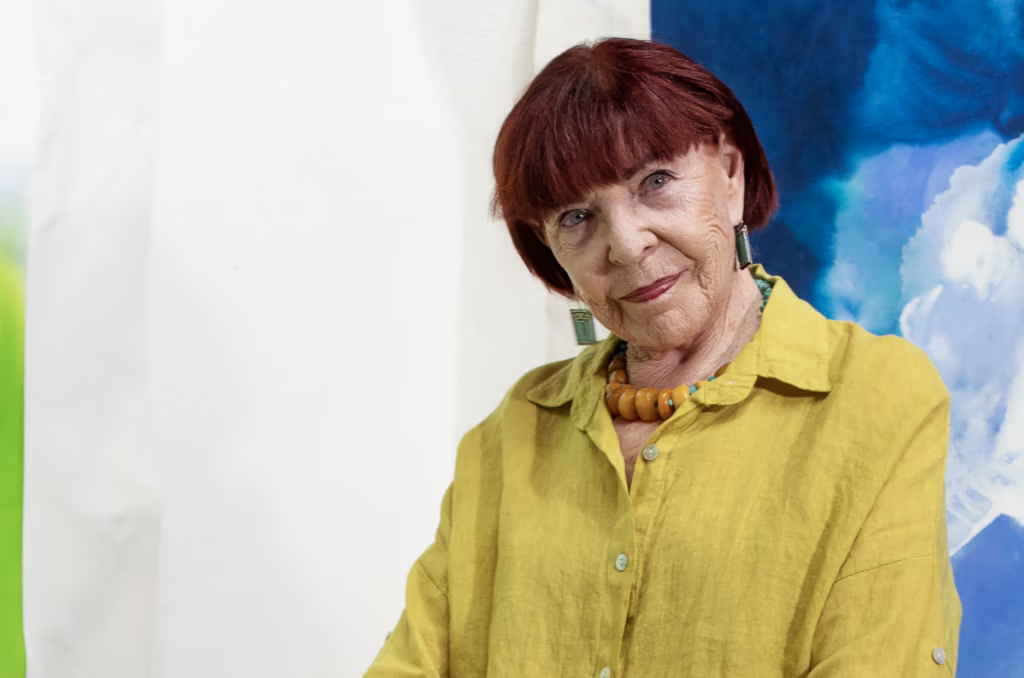
I TOOK A PHOTOGRAPHER WITH ME to Bette Ridgeway’s studio in Santa Fe, and we asked Bette to stand in front of several of her paintings. In all of the photos, she was smiling. Don’t smile this time, I suggested. What I realized in working with her was that even when her mouth didn’t smile, her eyes couldn’t stop smiling. She truly does reflect the light that she tries to capture in her paintings. Unlike most painters we’ve interviewed who use brushes, Bette pours her huge paintings, using different instruments under the canvas to create the flow the way she wants it to go. She has traveled widely, lived and worked on four continents, shown in more than eighty galleries and museums, and, since 1996, made her home and studio in Santa Fe. Her poured, layered canvases are built on what she calls frequency — color as vibration — and her new show, Spectral Luminosity, can be seen at LewAllen Galleries in the Railyard. She dedicates it to the late Arlene LewAllen.
— Lynn Atkison
You have a very large body of work, and you’ve shown in a lot of places, a lot of museums. When did you decide that you’re no longer someone who just paints, but that you were an artist?
I was four years old. My mother saw that I had talent. So she brought me really good supplies, not the standard supplies that kids get. She got me real watercolors, real oils.
And I remember one day everyone went off to church. We lived in a tiny town, Tupper Lake, New York. And I faked a bellyache because I didn’t want to go. So I sat there and I made little watercolors, and I placed them all over the house, stood them up on the sofa and chairs. When they came home, I said, Welcome to our gallery. These are five cents apiece. And I sold three of them. So at that time I said, I’m a professional. And it got better from there.
But I came into the world knowing — absolutely knowing — that was my job. And it was to bring light. I also told my grandparents I was from the Pleiades. Three years old: I’m from the Pleiades. My grandfather had to get some National Geographic out to look up that part of the sky. And one day they said, Why are you here? And I said, To bring light. No thinking.
And I forgot about that for years, until I was working on my memoirs, the beginning of this year. But my life has been focused on that: making beautiful art. And it all focuses on light and color. So I feel like I’m doing a good job. And I expect to do it for another twenty-five years.
What artist influenced you most?
I was painting figuratively until the late ‘70s. And I knew something was off. And I met Paul Jenkins, who’s a renowned abstract expressionist of the mid-century times in New York. And he kindly looked at my work, and he said, Take the subject matter out. You’re a colorist. So that opened the whole world of abstract art. Eight years later, he looked at my slides and said, You’re ready for the show. I landed a show in a gallery in Alexandria, Virginia. People were lined up around the block. Everything sold, and I said, okay, now I’m really professional. So I quit my day job.
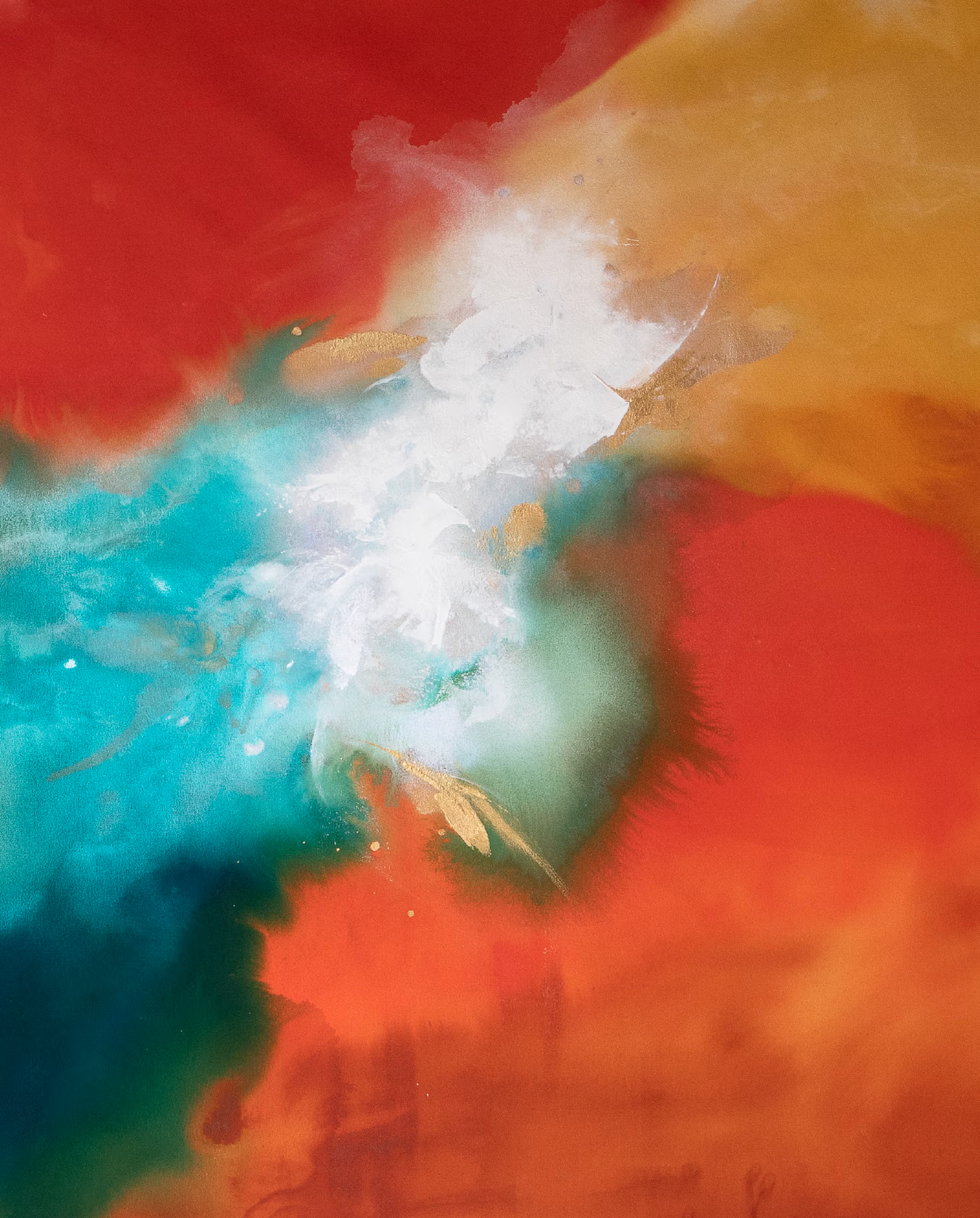
I do the pouring and the stain. Those are my two favorite ways to communicate. I’m communicating with color. And even more importantly, I’m communicating with frequency. Color has frequency, like music. We are all frequency.
When you start a new painting, how does that work?
I meditate before I paint. So I’m here, an open space where I can actually download painting. It comes to me like a big download. And so the paint is creating the work, and I’m following the direction of the paint. It’s telling me what to do next. And I know exactly when to stop. And then the title comes after I stop.
These canvases are draped on supports, stools. And under the canvas I create crevices and angles with boxes and baskets and little ladders. I create a place for the paint to go. Then I can reach in with the boomerang and push the paint or pull the paint.
How do you know when you’re done?
I just know. It tells me when I’m done. I call it intuitive painting. I’m just there to be the midwife. It’s coming through me, but it’s not mine. It’s like a child. I’m painting not a thing, but a moment.
I remember, in grade school, we had an art teacher. I remember doing a painting, and she came over and said, There’s no such thing as a yellow sky. I couldn’t believe it. And years later, I found myself deliberately doing yellow skies to prove her wrong. Because there are no rules. There are no rules.
When did you move to Santa Fe?
I had a wonderful friend and collector back in Virginia who has a daughter in Santa Fe. She would put an armload of magazines on my desk and tap on them: You belong in Santa Fe.
So I came out here in January or February of ‘96, stayed in Hotel Santa Fe with a little purple bus, and went up Canyon Road. I had envisioned Canyon Road as a big boulevard with beautiful glass-front galleries. And the bus driver said, These are all houses, you know. So I started walking from the top of Canyon Road down, and I stopped in every single gallery, and I could not believe the quality of the work, the kindness of the people. It was winter; they offered me some hot cider. Fireplaces were going with the piñon wood. And outside there was snow on the adobe and a cobalt sky. In two days I fell in love with Santa Fe, and went back home and started packing. I landed here in the beginning of May, and I met Phyllis Kapp — our beloved Phyllis Kapp, who just passed recently. And she invited me to have a show on the Plaza on Fourth of July weekend at Waxlander Gallery. That show sold out. So I felt like the spirit guides had really pushed me in the right direction.
There’s no humidity. We’re so high. The light is absolutely pure. We’re on a meridian. We’re on a high frequency. And we connect or we don’t.
Of all the countries you’ve lived in, did you have a favorite?
It’s like, do you have a favorite job? I’d have to say Madagascar. The local Malagasy women made their own fabrics. They would take breadfruit or some kind of squash and mix up paint and print on this fabric, beautiful colors. And they taught me how to make the fabric, too. There’s a reverence for the land and the food, the people very caring about their environment. And that’s kind of leaving us now. We’re losing that reverence for our planet and our people. I can only counter this by making beautiful things.
Sometimes I will make a mistake in my work, something that doesn’t look quite right. And I remember Jenkins saying to me, Don’t fix that. You’re a human being. This is not made by a machine. Don’t you go back in there and fix it. Leave it there. In recent years especially, I’ve let a few drips stay. And in the galleries, the clientele said, Why are all these drips? And the owners will say, Give the children the mandate to run around and count the drips.
Tell me about the show.
Early this year, I signed on with LewAllen Galleries in the Railyard. And the other connection I have is that Arlene LewAllen, the original owner —
I knew her. I was teaching at Santa Fe Prep back in the ‘70s. She was a teacher at Santa Fe Prep in middle school, and she left to go try to put together a gallery. And we all thought, Come on.
About a month before she passed in 2002, she would pop over and visit a lot. She said, Bette, I think you’re ready for a show. She was going to do it on the second story of that beautiful building — and then, sadly, she died. So for me, this is like coming home. And I want to dedicate this show to Arlene.
She was the kindest gallerist in the world. When I had my studio in the Railyard, she would come over after work and kick off her high heels and have a glass of cheap wine, because I couldn’t afford good wine. And she would chitchat about her day and who sold what. And I remember her saying to me, You and I are the last of the women who are still wearing pantyhose and high heels.
So now, with Ken Marvel, the owner of LewAllen — it’s like a museum in the Railyard. We have a working title, and that is Spectral Luminosity. It opens October 16.
Do you ever hit a creative wall?
I’m worried I’ll run out of time before I get everything done. While I’m working on one piece, I’m seeing the next one.
I can give you one example of a channeling experience. One day, working with my assistant, we were working on a very large poured piece, and I put down some beautiful red. There was a cadmium red. Then I put an ultramarine down with it. And then I grabbed kind of a rich gray and started working with that. And I looked over in the corner, and my little laptop was on — this was January 6th. I spent dozens of years in Washington. And we realized the insurrection was going on. We just shut down the studio. And the next morning I walked into the studio, and there it was: the desecration. Red, white, blue. The gray came over, and it was ugly. The gray cut right into it like a sword. And I said, There it is.
And I think part of that is opening that channel. Being open. Meditating a lot. So the frequency comes in. That’s the advice I give to artists: to meditate. Open yourself. Then it’ll come.